
Chinese American History with a focus on immigrant family life experiences

6/17/13
Could Chinese Attend White Schools in Mississippi in the 1950s?
Jin Jue, a Chinese who was born in and grew up in Mississippi during the 1950s shared his observations about how it was determined whether Chinese children could attend white public schools. Although Mississippi law at that time was unfavorable toward Chinese, he pointed out that the situation was not handled the same way in different communities:
Chinese rights to attend a white school were determined on a county by county basis. While my family attended a white school, my sister's husband was not allowed in the county he lived in, and he had to travel 40 miles to another county (to attend school).
One summer, my parents moved from Cary, Mississippi, where the Chinese attended a white school, to Warren County where there were no Chinese attending the local school. My dad asked a local customer when the local school was starting and where the bus stop was.
That morning of the first day of school, my dad sent my older brother and sisters out to stand at the bus stop to see what would happen. The bus came by, and my brother and sisters boarded the bus with the other (white) kids. As was common in those days, the Chinese parents never went with their kids to school. The kids had to fend for themselves and somehow were enrolled in their proper classes.
The bus driver, who most likely, never saw an Asian in his whole life, didn't know what to do about these strange looking (Chinese) kids boarding his bus. He could have refused to let them on (anyone can say no), but figured it was none of his business to decide what to do with these kids.
My brother and sisters arrived at school, and the teachers didn't know what to do, so probably the Principal was called and the matter placed in his hands. The Principal called the Superintendent of Education for the County and some time after much debate, a decision was made to let them enroll.
So the first integration of Chinese in (a) white school in Warren County was allowed because a bus driver was passive enough not to get involved, or wasn't "redneck" enough to say "No way they getting on my bus!!!,” which in turn started the chain of event that led to their eventual enrollment.
My discussions with other Chinese who grew up in the Delta between the 1940s and 1960s confirm Jin Jue's experience that in some towns Chinese were accepted into white schools with little difficulty while they were denied admission in other nearby towns. His cousin, Lillie, in fact, who stayed in Cary was able to attend white schools. Apparently if your father was well-regarded and or knew the 'right people' his kids found little opposition in attending white schools.

3/27/13
Were "Chinese Abused" in Rosedale, Mississpipi, in 1900?
Jean Pfaelzer's Driven Out: The Forgotten War Against Chinese Americans amply documents the violent expulsion of Chinese from many communities on the west coast during the late 19th and early 20th century. Fears that Chinese were taking away jobs from whites and sending money back to China rather than spending it here were major motivators.
However, such hostile and aggressive actions were not limited to that region of the country as reports of anti-Chinese violence came from places where the Chinese were so few in number that they could hardly have posed an economic threat. On Aug. 16, 1900, the Pawtucket Times in Rhode Island published an report, CHINESE ABUSED, originating from New Orleans that violent attacks against Chinese had occurred in Rosedale, Mississippi and that the beating of one "Chinaman" at Mellowdale had led to the arrest of several white men.
These attacks prompted a delegation of Chinese merchants to seek a meeting with Mississippi Govenor Longino requesting protection as all Chinese in Bolivar County had been ordered to leave the country within 5 days, notwithstanding the fact that they would have to abandon their property. The Governor wrote leaders of Bolivar calling their attention to the problems and urging them "to take hold of it."*
No subsequent reports seem to exist about the aftermath of the 1900 incidents. Given that Chinese merchants operated grocery stores in the following years in Rosedale and other parts of the Delta, calmer heads must have prevailed. Although the efforts to expel the Chinese failed, they were not exactly welcomed either. Rosedale was the same town where Gong Lum, a Chinese grocer, tried without success in the mid 1920s to enroll his daughters in the segregated white school in a case that went all the way to the U. S. Supreme Court, Gong Lum v. Rice, 1927 that was denied.
*However, the New Orleans Times Picayune newspaper, the alleged source of the Aug. 16, 1900 article about problems faced by Rosedale Chinese, published the article below on Aug. 17, 1900 in which it stated the earlier article was in error and that the three Chinese merchants in Rosedale "enjoy all the privileges, and have the same potection as any other law-abiding citizen."

*However, the New Orleans Times Picayune newspaper, the alleged source of the Aug. 16, 1900 article about problems faced by Rosedale Chinese, published the article below on Aug. 17, 1900 in which it stated the earlier article was in error and that the three Chinese merchants in Rosedale "enjoy all the privileges, and have the same potection as any other law-abiding citizen."

3/23/13
Counting How Many Chinese Live in Chinatown
What is going on in this photograph from New York Chinatown in 1925? Perhaps the white man is asking the Chinese man where he can find some good chop suey?

Well, actually the photograph shows a white census enumerator speaking to the Chinese man with two young children on a New York Chinatown street. One wonders whether he is seeking directions, just having a friendly conversation, or actually conducting a census interview right on the street. After all, living quarters in Chinatown were pretty crowded and Chinese may not have been eager to allow white strangers into their places of residence. If he is collecting census information, one wonders whether the Chinese man has sufficient command of English to understand the questions. And, whether he is anxious or suspicious about the uses that the data will have, especially if he is an illegal immigrant?
U. S. Census data serves many useful purposes for different fields of research and application including demography, social policy, history, immigration, migration, and genealogy. Given the difficulty and expense of locating people at their residences, there are still many people who are not counted and their demographic, occupational, and familial data are missing. Such issues are not as troublesome if one is primarily interested in determining general patterns or relative counts of the size of subgroups, but can be disastrous when one is searching for specific individuals.
I found a fascinating blog post recently (first of nine posts) by writer S. Tremaine Nelson describing how he and two friends, one an artist and the other a photographer, made some naturalistic or ethnographic observations in a small public area, Columbus Park, in the heart of New York's Chinatown. His blog post provides transcripts of their comments and interpretations of the observed patterns of behavior and social interactions among people, accompanied by wonderful candid black and white photographs. Their work provides a qualitative portrait of the Chinese community in contrast to a census enumeration which focuses on quantitative aspects. Nelson wrote:

The part of Nelson's post that grabbed my attention was his explanation for how he became interested in making his study of Chinatown daily public life. I am only going to describe these background experiences that led the author to decide to make the naturalistic observations in the first place because those experiences illustrate some major weaknesses of census data collection that are rarely discussed. I will not discuss their actual observations and analyses, intriguing and enlightening as they are, but I encourage you to read the posts in their entirety,
Specifically, in 2010 Nelson worked for the Census Bureau in New York's Chinatown. He was struck by the huge disparity in the count of residents (15) that a field-worker obtained and the count (70) that a Chinese-speaking co-worker obtained from followup phone calls made to check on reliability of results at a single address that served as a dormitory where Chinese male workers rented bunks, stacked four high in a 10 ft. x 10 ft. room, by the hour.
Nelson described the procedures used by the Chinese-speaking coworker.

Thus, 'residents' only spent a few hours at this dormitory, with different shifts of workers sleeping there at different hours throughout the day. By taking samples at different hours, the count continued to increase whereas a single sample would yield a much smaller count.
This example illustrates one of the many unforeseen problems that can yield inaccurate census information. If the census enumerator had knowledge of the living conditions of working men in Chinatown, the undercount might not have occurred.

Well, actually the photograph shows a white census enumerator speaking to the Chinese man with two young children on a New York Chinatown street. One wonders whether he is seeking directions, just having a friendly conversation, or actually conducting a census interview right on the street. After all, living quarters in Chinatown were pretty crowded and Chinese may not have been eager to allow white strangers into their places of residence. If he is collecting census information, one wonders whether the Chinese man has sufficient command of English to understand the questions. And, whether he is anxious or suspicious about the uses that the data will have, especially if he is an illegal immigrant?
U. S. Census data serves many useful purposes for different fields of research and application including demography, social policy, history, immigration, migration, and genealogy. Given the difficulty and expense of locating people at their residences, there are still many people who are not counted and their demographic, occupational, and familial data are missing. Such issues are not as troublesome if one is primarily interested in determining general patterns or relative counts of the size of subgroups, but can be disastrous when one is searching for specific individuals.
I found a fascinating blog post recently (first of nine posts) by writer S. Tremaine Nelson describing how he and two friends, one an artist and the other a photographer, made some naturalistic or ethnographic observations in a small public area, Columbus Park, in the heart of New York's Chinatown. His blog post provides transcripts of their comments and interpretations of the observed patterns of behavior and social interactions among people, accompanied by wonderful candid black and white photographs. Their work provides a qualitative portrait of the Chinese community in contrast to a census enumeration which focuses on quantitative aspects. Nelson wrote:

The part of Nelson's post that grabbed my attention was his explanation for how he became interested in making his study of Chinatown daily public life. I am only going to describe these background experiences that led the author to decide to make the naturalistic observations in the first place because those experiences illustrate some major weaknesses of census data collection that are rarely discussed. I will not discuss their actual observations and analyses, intriguing and enlightening as they are, but I encourage you to read the posts in their entirety,
Specifically, in 2010 Nelson worked for the Census Bureau in New York's Chinatown. He was struck by the huge disparity in the count of residents (15) that a field-worker obtained and the count (70) that a Chinese-speaking co-worker obtained from followup phone calls made to check on reliability of results at a single address that served as a dormitory where Chinese male workers rented bunks, stacked four high in a 10 ft. x 10 ft. room, by the hour.
Nelson described the procedures used by the Chinese-speaking coworker.

This example illustrates one of the many unforeseen problems that can yield inaccurate census information. If the census enumerator had knowledge of the living conditions of working men in Chinatown, the undercount might not have occurred.
2/26/13
A Site of Great Significance at 965 Clay Street, San Francisco

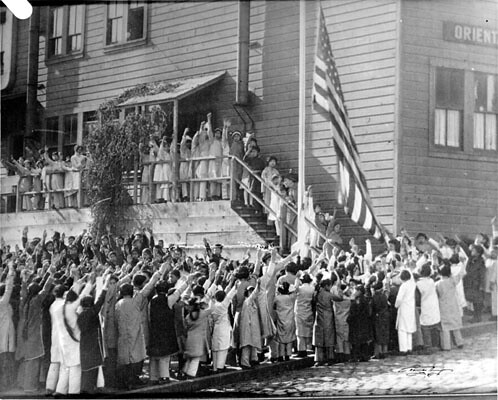
Its significance for the Chinese community of San Francisco goes back much further to around the 1906 quake and fire when the same site (see superimposed image below) was used to build the Oriental School for Chinese and other Asian children who were not allowed to attend white schools.

This site was also where a turf battle between Chinese and white youth led to the accidental shooting in 1912 by a Chinese boy that led to the death one white boy as detailed in an earlier post on this blog.
2/16/13
Chinese and School Segregation in Mississippi Before 1950
Separate schools existed for blacks and whites in the Deep South for many decades, but where did Chinese children, and others of Asian descent, attend school?
In Mississippi, the State Constitution of 1890 specified that white schools were for caucasians only, a view that the U. S. Supreme Court in 1927 upheld in Gong Lum v. Rice when a Chinese grocer in Rosedale failed to get his two daughters admitted to white schools in 1924. Consequently, until the late 1940s Chinese in the Delta had to form their own schools with the help of the Baptist church to educate their children although enforcement of school segregation policy against Chinese varied widely in different communities. In some towns, it was rigidly enforced while it was ignored in other towns.
For example, on Feb. 21, 1941 the School Board in Clarksdale denied a petition supported by the Clarksdale Baptist Church pastor and 88 citizens for admission of the 7-yr old daughter, May (Magen) of Henry and Edith Jue to a white school for the 1941-2 school year. In the minutes of the meeting, Jue was referred to as "Chinaman." Furthermore, his name was misspelled as "Jeel" and the name of the daughter, May, was not specified.

However, on September 3, 1941 the School Board, despite the opposition of 30 petitioners, granted "conditional admission" to a white school for May on the grounds that the Chinese school that she had been attending in nearby Lula had been discontinued. However, the decision was clearly described as "subject to revocation at any time." Mr. Jue's name was still misspelled in the minutes, but this time as "Jeu" instead of "Jeel."

 |
In 1941, Henry and Edith Jew (Jue), accompanied May (Magen) on the first day of class to the white school, Oakhurst Elementary School, Clarksdale, MS.
|
In 1950, fully a decade later, it was still necessary for School Board approval before May's cousins, Chat and Ben Sue, could attend a white school in Clarksdale for the 1950-51 school year.

It must be noted that these inroads were made before the 1954 U. S. Supreme Court ruling against school segregation in the historic Brown v. Board of Education decision.
Times do change, and for the Chinese in the Delta, their status improved substantially since 1941 as they made valuable contributions to their communities over the years. In 2012, the Clarksdale newspaper gave recognition of the breaking of the racial barriers at school by the Jue family, paving the way for other Chinese children in the following years.

Source of documents: Betty Jue Dickard
2/15/13
Deportation And Chinese Stool Pigeons
Most deportation cases were initiated by federal authorities who brought charges against suspected illegal Chinese immigrants. However, there were also cases where a Chinese would be deported based on a tip to the immigration authorities, usually anonymous, from another Chinese who, perhaps, had some grudge against him. The letter below in 1925 from the Customs Service of the U. S. Treasury Department notifies the Commissioner of Immigration at Ellis Island that an anonymous informant identified a Chinese without a passport and the address of a laundry where he could be found. The hand written note is attached to the letter.


In another case (undated), a Chinese named Charley Sung sent the letter below (translated from Chinese) informing authorities that Ng King in Newark, New Jersey, was not only smuggling Chinese into the country from Mexico but was also dealing opium. One might suppost that the informant was exacting some type of revenge against Ng King.
Interestingly, the translator prefaces the name of the informant, Charley Sung, with the identifier, Chinaman. No further information was found about the outcome of the investigation.

http://njdigitalhighway.org/exhibits/chinese_exclusion/index.php
2/5/13
Self Deportation By A Chinese Immigrant in 1941
When we think of immigration problems facing the Chinese, what generally comes to mind are the federal barriers, which were formidable and numerous, either preventing entry or prompting deportation.
In addition, there were less well-known procedures that led to deportation of Chinese immigrants. Long before 2012 Presidential candidate Milt Romney advocated "self-deportation" for dealing with the immigration issue, such a mechanism already was available for a Chinese who wanted to be deported! However, you could not just leave the country but first had to complete an application form for the U. S. Department of Labor.
Consider the case of 85-year old Oung Don You in New Jersey who entered the U. S. at age 14 as a laborer in 1893 but in his old age become dependent on public assistance. In 1941, which was not exactly an ideal time to return to China in view of the war with Japan, he voluntarily filed for 'removal to native country' and was promptly deported.

Inasmuch as Oung was destitute, his passage back to China was probably at the expense of the Immigration Service. Perhaps that was why he had to first complete the application form.

Source: http://njdigitalhighway.org/exhibits/chinese_exclusion/index.php
In addition, there were less well-known procedures that led to deportation of Chinese immigrants. Long before 2012 Presidential candidate Milt Romney advocated "self-deportation" for dealing with the immigration issue, such a mechanism already was available for a Chinese who wanted to be deported! However, you could not just leave the country but first had to complete an application form for the U. S. Department of Labor.
Consider the case of 85-year old Oung Don You in New Jersey who entered the U. S. at age 14 as a laborer in 1893 but in his old age become dependent on public assistance. In 1941, which was not exactly an ideal time to return to China in view of the war with Japan, he voluntarily filed for 'removal to native country' and was promptly deported.

Inasmuch as Oung was destitute, his passage back to China was probably at the expense of the Immigration Service. Perhaps that was why he had to first complete the application form.

Source: http://njdigitalhighway.org/exhibits/chinese_exclusion/index.php
1/31/13
1892 Requirement of Certificates of Residence for Chinese
The infamous 1882 Chinese Exclusion Act attempted to prevent Chinese laborers from entering the U. S. while admitting Chinese merchants. Originally intended to last 10 years, it was extended several times, first in 1892 with the Geary Act that under Section 6 required all Chinese laborers to have a "Certificate of Residence" such as the one below in their possession at all times or risk deportation.
".... any Chinese laborer, within the limits of the United States, who shall neglect, fail, or refuse to comply with the provisions of this act, or who, after one year from the passage hereof, shall be found within the jurisdiction of the United States without such certificate of residence, shall be deemed and adjudged to be unlawfully within the United States, and may be arrested, by any United States customs official, collector of internal revenue or his deputies, United States marshal or his deputies, and taken before a United States judge, whose duty it shall be to order that he be deported from the United States."


".... any Chinese laborer, within the limits of the United States, who shall neglect, fail, or refuse to comply with the provisions of this act, or who, after one year from the passage hereof, shall be found within the jurisdiction of the United States without such certificate of residence, shall be deemed and adjudged to be unlawfully within the United States, and may be arrested, by any United States customs official, collector of internal revenue or his deputies, United States marshal or his deputies, and taken before a United States judge, whose duty it shall be to order that he be deported from the United States."

A noted Chinese artist, Hung Liu, now working in Oakland, California, created an "artistic protest" of the required "dog tag" that the Certificate of Residence represented with her satirical creation cleverly named, "Resident Alien" Card.

A commentary by Dong Li Isbrister pointed out some of the clever aspects that Liu used in her creation such as her fictitious name, Cookie, Fortune.

Another burden imposed on Chinese who wanted to make temporary visits to China or other places outside the U. S. was the requirement that they file an application to leave and reenter at least a month in advance before they wanted to depart. Two witnesses, preferably white because Chinese generally had low credibility, had to sign the application certifying that they knew the applicant to be worthy of reentry.
If they were laborers, as was the case in the example below, they had to have assets of at least $1,000 in property and/or debts owed to them in the U. S. to be eligible for reentry.

These burdensome requirements placed upon the Chinese reflected the attempts of Immigration authorities to reduce the Chinese population in the United States. Chinese leaving the country might find it difficult to reenter even with valid documents because Immigration officials knew that some Chinese acquired them fraudulently. Consequently, even Chinese with documents that belonged to them were suspect and interrogated intensively when returning from trips out of the U. S.
1/30/13
Chinatown Turf Wars Between Chinese and White Children
Today, one can find Chinese living throughout the city of San Francisco but a century ago, racial animosity toward Chinese restricted them to living in the confined area known as "Chinatown," which did not extend west beyond Stockton Street until the early 1900s.
Due to prejudices against them, Chinese elementary school students were not allowed to attend white schools as far back as 1859. In fact, San Francisco did not fund any schools at all for Chinese until the landmark 1885 Tape v. Hurley case which required the S. F. Board of Education provide public education to Chinese. The city lost the case but maintained its exclusion of Chinese from white schools by building a segregated "Chinese Primary School." It was renamed, "Oriental Public School" (when it was decided to segregate Japanese students as well) in 1906. Sometime after the April, 1906 earthquake, the school was rebuilt on Clay Street halfway up the hill between Stockton and Powell Streets. Below is a photograph of the school sometime around 1908.
 |
| Oriental School, Clay Street |
 |
| Oriental School (Fairmont Hotel in Background) |
"Any oriental school located outside of oriental territory near to any school of the Caucasian race will greatly injure the discipline of each school, as a constant race war will be kept up between the boys of the schools."
Perhaps these protests were triggered by the tragic event earlier that year in February involving a stone throwing confrontation between Chinese and white students near the Oriental School. At one point, a group of white boys found themselves trapped between two groups of Chinese boys so one of them, Jose Aguilar, fired a B. B. shot air rifle twice hoping to frighten the Chinese so they could escape. However, Wong She*, a 10-year old Chinese boy had a gun and fired back. One bullet passed through Aguilar's coat sleeve as he ran and fatally struck James Kane, a 14-year old white boy in the school yard. The newspaper account described Wong as "a gunman of the powerful Wong family" and reported that "four companions of the slain youth picked out Wong as the man last seen chasing the boy." One Chinese boy testified he saw Wong She carrying the body of Kane.

San Francisco Call, Volume 111, Number 64, 2 February 1912, 1.
On Feb 12, Judge Weller, to the surprise of most, granted bail at $5,000, defending his unpopular decision on the grounds that "Chinese witnesses were not reliable."
At the May 19 trial, the jury was unable to reach a verdict on the guilt of the accused as much of the evidence against the prisoner was worked up by detectlves as the result of statements by schoolmates of James Kane. Ten of the jurymen found in favor of conviction for manslaughter, while two held out for murder. A second trial was to be set by Judge Dunne.**
Dominic Kane, father of the slain boy, upon hearing the verdict, whipped out a .44 caliber revolver and tried to avenge his son's death. A sharp struggle ensued to remove the revolver from the man's grasp, and total chaos was averted as over 50 Chinese were present, and apparently, ready to defend the Chinese boy.
In the present day context of school shootings, the Wong-Kane case is erroneously included in a listing of school shootings:
January 31, 1912: San Francisco, California In a brawl between the white and Chinese students at the Oriental School, James Kane was shot dead.[59]
The tragic Wong-Kane case did not occur in a school nor did it involve students at the same school. It is the story of how hostility of one group toward another group can escalate into further harm and tensions between the opposing groups.
* "She" may be a misspelled name and might have been "Shee."
** No information could be found about the second trial or what happened to Wong She.
1/25/13
Nutritional Analysis of Chinese Immigrant Diets
Early Chinese immigrants worked long hours on farms, in laundries,
restaurants, and grocery stores, generally with meager amounts of food to eat. Observers were curious about the characteristics of the Chinese diet that enabled them to survive their long labors, and wanted to determine if it was a nutritious and
healthy fare.
In 1900,
Professor Myer E. Jaffa, a highly respected chemist who was the first professor of nutrition
at the University of California in Berkeley undertook a research study
to measure what a sample of 12 Chinese workers ate over 18 consecutive days.
A newspaper account of the research reported in the San Francisco Call began with derogatory insinuations about the palatability of Chinese food.

The study compared three groups of Chinese, professionals, laundrymen, and gardeners, based on the
extent of physical labor involved with their occupations, as noted by the
reporter.

The article summarized some of the findings but only after
first making light of one Chinese who was suspicious initially that the study was a
veiled attempt to tax him for the amount of food he ate. The reporter also described the types
of food that laborers ate as things that “sound strange to the Caucasian ear,
and taste stranger yet to his palate.”

The reported finished with Prof. Jaffa’s findings that the total
protein each day was low, as the Chinese had little meat and relied on a low-fat diet. He felt that their diet
had “an ample amount of nutrition.”

M. E. Jaffa, "Nutrition
Investigations Among Fruitarians and Chinese at the California Agricultural
Éxperiment Station, 1899-1901," U.S.D.A. Office
of Experiment Stations, Bulletin No. 107,
Washington, DC, 1901.
Subscribe to:
Posts (Atom)