About Me

After a career of over 40 years as an academic psychologist, I started a new career as a public historian of Chinese American history that led to five Yin & Yang Press books and over 100 book talks about the lives of early Chinese immigrants and their families operating laundries, restaurants, and grocery stores. This blog contains more research of interest to supplement my books.

2/15/13

Deportation And Chinese Stool Pigeons

         Most deportation cases were initiated by federal authorities who brought charges against suspected illegal Chinese immigrants. However, there were also cases where a Chinese would be deported based on a tip to the immigration authorities, usually anonymous, from another Chinese who, perhaps, had some grudge against him.  The letter below in 1925 from the Customs Service of the U. S. Treasury Department notifies the Commissioner of Immigration at Ellis Island that an anonymous informant identified a Chinese without a passport and the address of a laundry where he could be found.  The  hand written note is attached to the letter.


        In another case (undated), a Chinese named Charley Sung sent the letter below (translated from Chinese) informing authorities that Ng King in Newark, New Jersey, was not only smuggling Chinese into the country from Mexico but was also dealing opium. One might suppost that the informant was exacting some type of revenge against Ng King.

       Interestingly, the translator prefaces the name of the informant, Charley Sung, with the identifier, Chinaman. No further information was found about the outcome of the investigation.


http://njdigitalhighway.org/exhibits/chinese_exclusion/index.php

2/5/13

Self Deportation By A Chinese Immigrant in 1941

    When we think of immigration problems facing the Chinese, what generally comes to mind are the federal barriers, which were formidable and numerous, either preventing entry or prompting deportation.  
       In addition, there were less well-known procedures that led to deportation of Chinese immigrants. Long before 2012 Presidential candidate Milt Romney advocated "self-deportation" for dealing with the immigration issue, such a mechanism already was available for a Chinese who wanted to be deported!  However, you could not just leave the country but first had to complete an application form for the U. S. Department of Labor. 
        Consider the case of 85-year old Oung Don You in New Jersey who entered the U. S. at age 14 as a laborer in 1893 but in his old age become dependent on public assistance. In 1941, which was not exactly an ideal time to return to China in view of the war with Japan, he voluntarily filed for 'removal to native country' and was promptly deported. 


       Inasmuch as Oung was destitute, his passage back to China was probably at the expense of the Immigration Service. Perhaps that was why he had to first complete the application form.


Source: http://njdigitalhighway.org/exhibits/chinese_exclusion/index.php


1/31/13

1892 Requirement of Certificates of Residence for Chinese

The infamous 1882 Chinese Exclusion Act attempted to prevent Chinese laborers from entering the U. S. while admitting Chinese merchants. Originally intended to last 10 years, it was extended several times, first in 1892 with the Geary Act that under Section 6 required all Chinese laborers to have a "Certificate of Residence" such as the one below in their possession at all times or risk deportation.

".... any Chinese laborer, within the limits of the United States, who shall neglect, fail, or refuse to comply with the provisions of this act, or who, after one year from the passage hereof, shall be found within the jurisdiction of the United States without such certificate of residence, shall be deemed and adjudged to be unlawfully within the United States, and may be arrested, by any United States customs official, collector of internal revenue or his deputies, United States marshal or his deputies, and taken before a United States judge, whose duty it shall be to order that he be deported from the United States."


A noted Chinese artist, Hung Liu, now working in Oakland, California, created an "artistic protest" of the required "dog tag" that the Certificate of Residence represented with her satirical creation cleverly named, "Resident Alien" Card.   


A commentary by Dong Li Isbrister pointed out some of the clever aspects that Liu used in her creation such as her fictitious name, Cookie, Fortune.


Another burden imposed on Chinese who wanted to make temporary visits to China or other places outside the U. S. was the requirement that they file an application to leave and reenter at least a month in advance before they wanted to depart. Two witnesses, preferably white because Chinese generally had low credibility, had to sign the application certifying that they knew the applicant to be worthy of reentry.  

If they were laborers, as was the case in the example below, they had to have assets of at least $1,000 in property and/or debts owed to them in the U. S. to be eligible for reentry.


These burdensome requirements placed upon the Chinese reflected the attempts of Immigration authorities to reduce the Chinese population in the United States. Chinese leaving the country might find it difficult to reenter even with valid documents because Immigration officials knew that some Chinese acquired them fraudulently. Consequently, even Chinese with documents that belonged to them were suspect and interrogated intensively when returning from trips out of the U. S.


1/30/13

Chinatown Turf Wars Between Chinese and White Children


     Today, one can find Chinese living throughout the city of San Francisco but a century ago, racial animosity toward Chinese restricted them to living in the confined area known as "Chinatown," which did not extend west beyond Stockton Street until the early 1900s.
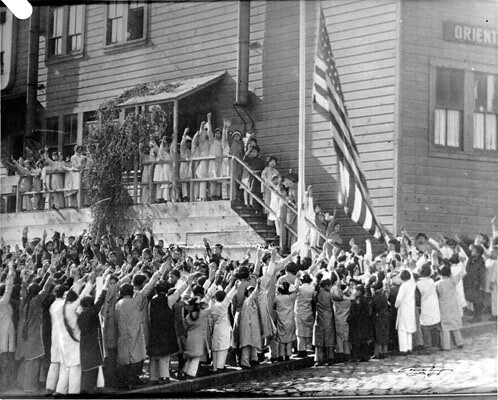
         Due to prejudices against them, Chinese elementary school students were not allowed to attend white schools as far back as 1859. In fact, San Francisco did not fund any schools at all for Chinese until the landmark 1885 Tape v. Hurley case which required the S. F. Board of Education provide public education to Chinese. The city lost the case but maintained its exclusion of Chinese from white schools by building a segregated "Chinese Primary School." It was renamed, "Oriental Public School" (when it was decided to segregate Japanese students as well) in 1906.  Sometime after the April, 1906 earthquake, the school was rebuilt on Clay Street halfway up the hill between Stockton and Powell Streets.  Below is a photograph of the school sometime around 1908.

San Francisco’s “Oriental School”
Oriental School, Clay Street
Oriental School (Fairmont Hotel in Background)
                        
           Although the Oriental School was already on Clay Street for several years, in October, 1912 protests were made at the Board of Education over its proximity to white schools. One protest leader argued that: 

"Any oriental school located outside of oriental territory near to any school of the Caucasian race will greatly injure the discipline of each school, as a constant race war will be kept up between the boys of the schools."


       Perhaps these protests were triggered by the tragic event earlier that year in February involving a stone throwing confrontation between Chinese and white students near the Oriental School. At one point, a group of white boys found themselves trapped between two groups of Chinese boys so one of them, Jose Aguilar, fired a B. B. shot air rifle twice hoping to frighten the Chinese so they could escape. However, Wong She*, a 10-year old Chinese boy had a gun and fired back. One bullet passed through Aguilar's coat sleeve as he ran and fatally struck James Kane, a 14-year old white boy in the school yard. The newspaper account described Wong as "a gunman of the powerful Wong family" and reported that "four companions of the slain youth picked out Wong as the man last seen chasing the boy."  One Chinese boy testified he saw Wong She carrying the body of Kane.


                         San Francisco Call, Volume 111, Number 64, 2 February 1912, 1.

        On Feb 12, Judge Weller, to the surprise of most, granted bail at $5,000, defending his unpopular decision on the grounds that "Chinese witnesses were not reliable."
       At the May 19 trial, the jury was unable to reach a verdict on the guilt of the accused as much of the evidence against the prisoner was worked up by detectlves as the result of statements by schoolmates of James Kane. Ten of the jurymen found in favor of conviction  for manslaughter, while two held out for murder. A second trial was to be set by Judge Dunne.**
        Dominic Kane, father of the slain boy, upon hearing the verdict, whipped out a .44 caliber revolver and tried to avenge his son's death.  A sharp struggle ensued to remove the revolver from the man's grasp, and total chaos was averted as over 50 Chinese were present, and apparently, ready to defend the Chinese boy.
        In the present day context of school shootings, the Wong-Kane case is erroneously included in a listing of school shootings:  

January 31, 1912: San Francisco, California In a brawl between the white and Chinese students at the Oriental School, James Kane was shot dead.[59]
         
        The tragic Wong-Kane case did not occur in a school nor did it involve students at the same school. It is the story of how hostility of one group toward another group can escalate into further harm and tensions between the opposing groups.


* "She" may be a misspelled name and might have been "Shee."
** No information could be found about the second trial or what happened to Wong She.

1/25/13

Nutritional Analysis of Chinese Immigrant Diets


         Early Chinese immigrants worked long hours on farms, in laundries, restaurants, and grocery stores, generally with meager amounts of food to eat.  Observers were curious about the characteristics of the Chinese diet that enabled them to survive their long labors, and wanted to determine if it was a nutritious and healthy fare.
         In 1900, Professor Myer E. Jaffa, a highly respected chemist who was the first professor of nutrition at the University of California in Berkeley undertook a research study to measure what a sample of 12 Chinese workers ate over 18 consecutive days.
    A newspaper account of the research reported in the San Francisco Call began with derogatory insinuations about the palatability of Chinese food.


     The study compared three groups of Chinese, professionals, laundrymen, and gardeners, based on the extent of physical labor involved with their occupations, as noted by the reporter.


       The article summarized some of the findings but only after first making light of one Chinese who was suspicious initially that the study was a veiled attempt to tax him for the amount of food he ate.  The reporter also described the types of food that laborers ate as things that “sound strange to the Caucasian ear, and taste stranger yet to his palate.”


        The reported finished with Prof. Jaffa’s findings that the total protein each day was low, as the Chinese had little meat and relied on  a low-fat diet. He felt that their diet had “an ample amount of nutrition.”


M. E. Jaffa, "Nutrition Investigations Among Fruitarians and Chinese at the California Agricultural Éxperiment Station, 1899-1901," U.S.D.A. Office of Experiment Stations, Bulletin No. 107, Washington, DC, 1901.


1/20/13

Hung Liu's Parody of 1892 Chinese Registration Certificate Requirement

       As if the Chinese Exclusion Act of 1882 was not sufficiently degrading for Chinese, when it was extended in 1892 for another decade with the Geary Act, they were required to apply for an identity card or Certificate of Registration that they had to have with them at all times or risk deportation, as specified in Section 6. (Although some countries, including China, have or plan to have national identity cards, it would apply to all residents, and not just to one ethnic group as with the Geary Act)

Section 6 of the Geary Act (1892) that extended the 1882 Exclusion Law.

Example of A Certificate of Residence for A Laborer

Hung Liu, an activist artist living in the Bay Area was a child of the Cultural Revolution in Mao's China who left for the United States in 1984. Her work is strongly influenced by these roots as she noted, "History is not a static image or a frozen story. It is not a noun. Even if its images and stories are very old, it is always flowing forward. History is a verb. The new paintings are my way of painting life back into my memories of a propaganda film that, over time, has become a document of the revolutionary sincerity that permeated my childhood."
   In her 1988 installation, Resident Alien, Liu expressed her contempt for the outrageous identity certificate requirement imposed on Chinese in America with her mocking back-in-your-face defiant rendition of an identity card.


Excerpt from"Self As Diasporic Body: Hung Liu’s Self-Portrait Resident Alien"
by Dong Li Isbister Ohio State University, 2009

1988 Installation at Capp Street Project Archives, San Francisco


1/19/13

An Ethnocentric View of Chinese Music


William H. Brewer, a Professor of Agriculture at Yale University, wrote about his impressions of early California from 1860 to 1864 in a journal which was published by Yale University in 1930. These observations provide a rare and detailed view of how life in California appeared to an educated traveller.

   In the preface by Russell H. Chittenden, Professor Brewer is praised in these glowing terms:

A close observer, a careful and sagacious thinker, slow to arrive at a conclusion until all the facts were available, he embodied all those attributes that contribute to success in the conduct of any investigation that calls for wise judgment and logical reasoning. As these letters show, even in his younger days, at the time when he became the “principal assistant” in this survey of California, he it was who had the knowledge and the power to take charge of and carry through a scientific enterprise, under conditions often far from favorable, and without doubt such success as the survey attained was due in no small measure to his resourceful leadership in the field.


During his visit to San Francisco, Brewer was curious to learn about the Chinese, and even attended a Chinese theatrical performance.  In the excerpt below where he describes his reaction to Chinese 'music,' he seems to have lost his objectivity in his appraisal.  He did not find much to his liking, and did not hesitate to mock that which he did not understand.


And these were the views of a man considered to have "wise judgment and logical reasoning." One shudders to think of what the common man in the street thought about the musicality of the Chinese.

1/11/13

Teaching Chinese American History to School Kids

        Elementary school history books include virtually nothing about the story of Chinese immigrants who came to North America in the 19th century other than to acknowledge their labor in helping build railroads.  Why did they leave their homes, and often wives and children, to come to these shores?  How, and why, did so many of them work in family businesses such as laundries, restaurants, and grocery stores? What harsh racial discrimination, including exclusion laws, did they face? What were 'paper sons' and why did Chinese resort to this device? Why did Chinatowns exist and how did they serve Chinese and non-Chinese in different ways?  How did they overcome huge obstacles to achieve the 'American dream' for themselves and their descendants, making significant contributions to their new homeland?

      I had an opportunity in 2011 to present a class talk covering all of these topics, and more, in an hour to 5th graders  at the Campus School at the University of Memphis.  Students showed an active interest and I hope that the lesson I provided stimulated their awareness and curiosity about this ignored aspect of our history, and will help promote their understanding of racial issues.

     One topic that fascinated some of the students was the discovery of poems etched on the wood walls of the Angel Island Immigration Station barracks by Chinese detained there, some for more than a month or two.  I read several of these poignant and heart-breaking poems to the class. During the Q&A, one eager student asked where he could find the poems as he wanted to read more of them!  That reaction alone made my day and I viewed it as one sign that my talk was a success!

12/27/12

History of Chinese in Grand Rapids, Michigan

Why is the history of Chinese in Grand Rapids, Michigan, so noteworthy?  It may have been similar to the history of Chinese in many other cities of its size in some other parts of the country. However, the Grand Rapids Historical Commission has created an outstanding record of the Chinese (as well as all other ethnic groups, I should add) in their community using documents and photographs using text and audio presentations.

The excerpt below from their website gives a bit of historical context, followed by a description of the first three Chinese, all in the laundry business, as described in a podcast.


"The Chinese entered the laundry business because they were kept out of any job where they were seen as taking "American" jobs, plus it was a business that could be started with almost no capital. The Chinese Exclusion Act of 1882 was renewed for ten years in 1892 by the Geary Act, and again in 1902 with no terminal date. This kept most Chinese out of the country and prohibited them from obtaining citizenship until it was repealed in 1943. Unless they were a relative of someone here prior to 1882 or a "paper son" they were excluded from entry. Some of the newspaper articles in our on-line archive describe the indignities suffered by these immigrants."

"The first Chinese residents of Grand Rapids were three men working in the laundry business ca. 1875. Wau Lee and Ah Tun were at 19 Canal St. Lung Sam operated his O.K.Laundry under the Rathbun House, an hotel located at 31 Monroe, until 1880 when Fee(Fu) King is listed as the operator. After 1880 Young Joe became the owner of the Rathbun House laundry. In 1889 Lam Fook, the proprietor of the O. K. Laundry who had lived here for two years, was found dead in his “dark, damp basement room by his partners, Wong Young and Lee Tsee.” His belongings included a certificate of deposit for $100, many letters, a brass tobacco pipe, a bag of tobacco, and a few trinkets and charms."


The website proudly notes that in 1874, one of the most important Chinese in America, Wong Chin Foo, came to lecture in Grand Rapids, where he also filed his citizenship application, making him the first Chinese to become an American citizen. Wong Chin Foo started a bi-lingual newspaper, the Chinese American, and civil rights activist with the Chinese Equal Rights League of America, of which he was founder and secretary in 1892.

         The Grand Rapids Historical Commission website, as shown below, is exemplary as it posted a total of 30 documents related to the historical record of early Chinese in the community. We can only speculate that the story of the Chinese is Grand Rapids is similar for small groups of Chinese who settled in other communities, where they ran laundries initially, and then, as described in this podcast, some opened restaurants, all living as foreigners in an often hostile environment.


12/23/12

A Culturally Appropriate Chinese Funeral in 1904 in Washington, D. C.

     A Chinese laundryman, Moy Sue Wing, died suddenly of heart failure in 1904 in Washington, D. C.  Six fellow Chinese, described as "almond-eyed Chinamen" arranged for his funeral, which was fully described in the Washington Times of April 19, 1904, featuring a photograph of his friend, Moy Jim, kneeling at the open grave to deposit chickens, fake paper money, bowls of rice, a jug of wine, chopsticks, and tea cups, and a pot of tea.   The article noted that in addition to his six countrymen, the procession to the cemetery included about 600 curious white women and children onlookers.


No mention, however, was made as to whether the undertaker was Chinese, but judging from the situation in New York City noted in the previous post on this blog that there was no Chinese licensed undertaker until 1930, it is most likely than a caucasian undertaker was employed here, as throughout the country. Fortunately, for Moy Sue Wing, his friends were there to ensure that his funeral service followed Chinese customs and beliefs, one that thousands of other Chinese who died in places where they were the only Chinese would not have received.