About Me

After a career of over 40 years as an academic psychologist, I started a new career as a public historian of Chinese American history that led to five Yin & Yang Press books and over 100 book talks about the lives of early Chinese immigrants and their families operating laundries, restaurants, and grocery stores. This blog contains more research of interest to supplement my books.

6/10/20

Jee Gam, First Chinese Ordained Minister in the U.S., 1885


Jee Gam emigrated from China at age 14 and became a cook in the home of George Mooar, a Congregationalist minister. He converted to Christianity, joined the First Congregationalist Church in Oakland in 1870 and often worked as a court interpreter. The religious activism of Jee Gam and other Chinese Protestants helped advocate for Chinese American suffrage and oppose Chinese exclusion, an involvement that has received little recognition from historians. They faced obstacles as many Americans viewed the Chinese as heathens and questioned whether they would accept Christianity.

 After 25 years of service at a Congregational church, in 1885 Jee Gam became the first Chinese American ordained as a Congregationalist minister, even though he could not become a U.S. citizen.

Joy Gam delivered a speech in 1891 at the Chinese Mission in Santa Cruz, describing a visit he made to his village in China. They were interested in hearing about the American railroads,  machinery, and other wonderful inventions and asked him why Americans were so wise. Jee Gam saw this as an opening to preach to them, explaining that praying to God made their success possible.


6/7/20

San Francisco Chinatown "Dodged A Bullet" in 1890


As the number of Chinese emigrating to California grew rapidly during the 1850s, fears increased that they would take work opportunities away from whites. By 1882, prejudices against the Chinese led to many laws limiting the Chinese and ultimately to the Chinese Exclusion Act prohibiting entry of Chinese laborers.

An even stricter measure against the Chinese in San Francisco was proposed in 1890 when the San Francisco Board of Supervisors issued Order No. 2190 known as the Bigham Ordinance named after the Supervisor initiating the law) ordering all Chinese to vacate the location of Chinatown in the heart of the city and move to outer parts of town in South San Francisco near Kentucky and Railroad Streets, which as far as I could determine no longer exist.

Order No. 2190 designating the location and the district in which Chinese shall reside and carry on business in this city and county.
“The people of the city and county of San Francisco do hereby ordain as follows:"
Section 1. It is hereby declared to be unlawful for any Chinese to locate, reside, or carry on business within the limits of the city and county of San Francisco, except in that district of said city and county hereinafter prescribed for their location.
“Sec. 2. The following portions of the city and county of San Francisco are hereby set apart for the location of all Chinese who may desire to reside, locate, or carry on business within the limits of said city and county of San Francisco, to-wit: Within that tract of land described as follows: Commencing at the intersection of the easterly line of Kentucky street with the south-westerly line of First avenue; thence south-easterly along the southwesterly line of First avenue to the north-westerly line of I street; thence south-westerly along the north-westerly line of I street to the south-westerly line of Seventh avenue; thence north-westerly along the south-westerly line of Seventh avenue to the south-easterly line of Railroad avenue; thence north-easterly along the south-easterly line of Railroad avenue to Kentucky street; thence northerly along the easterly line of Kentucky street to the south-westerly line of First avenue and place of commencement.
“Sec. 3. Within sixty days after the passage of this ordinance all Chinese now located, residing in or carrying on business within the limits of said city and county of San Francisco shall either remove without the limits of said city and county of San Francisco or remove and locate within the district of said city and county of San Francisco herein provided for their location.
“Sec. 4. Any Chinese residing, locating, or carrying on business within the limits of the city and county of San Francisco contrary to the provisions of this order shall be deemed guilty of a misdemeanor, and upon conviction thereof shall be punished by imprisonment in the county jail for a term not exceeding six months.

 The Chief of Police Crowley filed a petition justifying the ordinance.


Several Chinese arrested for failing to move from Chinatown and facing jail time served as test cases, In re LEE SING et al. In re SING TOO QUAN et al.     Circuit Court, N. D. California  August 25, 1890

Judge Lorenzo Sawyer, a prominent judge who personally opposed* Chinese immigration, to his credit made his ruling based on the legality of the Ordinance, as sections of his ruling below show.
         
"The ordinance enacted by the city of San Francisco, known as the “Bingham Ordinance,” which requires all Chinese inhabitants to remove from the portion of the city theretofore occupied by them, outside the city and county of San Francisco, or to another designated part of the city and county, is void as being in direct conflict with the constitution, treaties, and statutes of the United States, particularly in the sense that it is discriminating and unequal in its operation, and an arbitrary confiscation of property without due process of law…
Upon what other people are these requirements, disabilities and punishments imposed? Upon none.
The obvious purpose of this order, is, to forcibly drive out a whole community of twenty-odd thousand people, old and young, male and female, citizens of the United States, born on the soil, and foreigners of the Chinese race, moral and immoral, good, bad, and indifferent, and without respect to circumstances or conditions, from a whole section of the city which they have inhabited, and in which they have carried on all kinds of business appropriate to a city, mercantile, manufacturing, and otherwise, for more than 40 years. Many of them were born there, in their own houses, and are citizens of the United States, entitled to all the rights, and privileges under the constitution and laws of the United States, that are lawfully enjoyed by any other citizen of the United States. They all, without distinction or exception, are to leave their homes and property, occupied for nearly half a century, and go, either out of the city and county, or to a section with prescribed limits, within the city and county, not owned by them, or by the city. This, besides being discriminating, against the Chinese, and unequal in its operation as between them and all others, is simply an arbitrary confiscation of their homes and property, a depriving them of it, without due process or any process of law. And what little there would be left after abandoning their homes, and various places of business would again be confiscated in compulsorily buying lands in the only place assigned to them, and which they do not own, upon such exorbitant terms as the present owners with the advantage given them would certainly impose. It must be that or nothing. There would be no room for freedom of action, in buying again. They would be compelled to take any lands, upon any terms, arbitrarily imposed, or get outside the city and county of San Francisco.
The discrimination against Chinese, and the gross inequality of the operation of this ordinance upon Chinese, as compared with others, in violation of the constitutional, treaty, and statutory provisions cited, are so manifest upon its face, that I am unable to comprehend how this discrimination and inequality of operation, and the consequent violation of the express provisions of the constitution, treaties and statutes of the United States, can fail to be apparent to the mind of every intelligent person, be he lawyer or layman."

Judge Sawyer concluded:

"That this ordinance is a direct violation, of, not only, the express provisions of the constitution of the United States, in several particulars, but also of the express provisions of our several treaties with China, and of the statutes of the United States, is so obvious, that I shall not waste more time, or words in discussing the matter. To any reasonably intelligent and well-balanced mind, discussion or argument would be wholly unnecessary and superfluous. To those minds, which are so constituted, that the invalidity of this ordinance is not apparent upon inspection, and comparison with the provisions of the constitution, treaties and laws cited,” discussion or argument would be useless. The authority to pass this order is not within any legitimate police power of the state. See, In re Tie Loy, 11 Sawy. 472, 26 Fed. Rep. 611; In re Ah Fong, 3 Sawy. 144; Chy Lung v. Freeman, 92 U. S. 275; In re Quong Woo, 7 Sawy. 531, 13 Fed. Rep. 229; Yick Wo v. Hopkins, 118 U. S. 356, 6 Sup. Ct. Rep. 1064; Ho Ah Kow v. Numan, 5 Sawy. 552.
    Let the order be adjudged to be void, as being in direct conflict with the constitution, treaties, and statutes, of the United States, and let the petitioners be discharged."

The Bigham Ordinance failed miserably but illustrates the extreme measures considered against the Chinese in the late 19th century. On the positive side is the fact that Judge Sawyer placed legal criteria above his own negative feelings about Chinese immigration in reaching his ruling against the ordinance to protect the rights of the Chinese.


*If they would never bring their women here and never multiply and we would never have more than we could make useful, their presence would always be an advantage to the State . . . so long as the Chinese don’t come here to stay . . . their labor is highly beneficial to the whole community . . . the difficulty is that they are beginning to get over the idea that they must go back. Then they will begin to multiply here and that is where the danger lies in my opinion. When the Chinaman comes here and don’t bring his wife here, sooner or later he dies like a worn out steam engine; he is simply a machine and don't leave two or three or a half dozen children to fill his place."

6/6/20

Geary Act (1892) Required Chinese to Carry Certificates of Residence

 The 1882 Chinese Exclusion Act was only valid for 10 years so the Geary Act was enacted in 1892 to extend the exclusion of Chinese laborers for another decade. It went beyond the 1882 law by adding a burdensome requirement that all Chinese had to carry on their person a Certificate of Residence such as shown below or risk deportation or imprisonment for one year if found without it. Application to the Collector of Internal Revenue required the testimony of two WHITE witnesses affirming they knew the applicant was a resident. The Certificate of Residence requirement applied to all Chinese, even those entitled to entry such as merchants.

Chinese resisted this requirement with only 3,169 of the estimated 110,000 Chinese in the country registering by the deadline. Qing Ow Yang, the Chinese vice consul in San Francisco, wrote to the government:

Do you know what the Geary bill means to the laboring Chinese in this country? It means, sir, that they are placed on the level with your dogs. If you have a dog, a black and tan, a Llewellyn setter, a pointer, you buy a license tag for it and fasten it to the dog’s collar, and the number in the dog’s tag is its immunity for arrest by the poundman. Under the Geary bill the laboring Chinese carry their number in their pocket and any man who so desires may stop them and demand to see their “tag”…

The Chinese Equal Rights League in New York and Brooklyn held that the bill imposed taxation without representation as Chinese immigrants had to pay the "illegal costs and expenses" of enforcing the law. As a concession to the Chinese, the McCreary amendment provided an additional six months for Chinese to register for the residency certificates.  Even so, only 13,242 Chinese laborers or 14 percent of those required by law to register, complied.

Several Chinese that refused to register for their certificate of residence brought suit that, upon appeal, was brought before the Supreme Court in Fong Yue Ting v. United States in 1893. Important questions brought before the Court was whether the Act violated the 1868 Burlingame Treaty with China, whether hard labor and deportation constituted cruel and unusual punishment and thus violated the Eighth Amendment, whether the Act violated Fifth and Sixth Amendments protections by permitting imprisonment with hard labor without prior indictment or jury trial, whether the act violated the Fourteenth Amendment's prohibition against the taking of property or liberty without due process, among other issues.

The Geary Act provisions for imprisonment and forced labor were invalidated by Wong Wing v. United States in 1896 with the Supreme Court ruling that non-citizens have rights to courts and due process under the Fifth and Sixth Amendments, but the government could still detain people pending deportation.
The Chinese Consulate, the Six Companies, and many Chinese in the U.S. stated that they refused to pay their way back to China if deported. The cost of arresting and deporting as many as 85,000 unregistered Chinese was estimated at more than $7 million, but Congress had authorized only $60,000 and failed to provide a mechanism for deportation within the Geary Act.

When Ny Look, a Chinese Civil War veteran was arrested in New York for failure to register, the U.S. Circuit Court in the Southern District of New York ruled that there were no deportation provisions in the law and as Look could not be detained indefinitely, therefore he should be released.

The required Certificate of Residence seems to have not been enforced frequently and ended in 1943 with the repeal of the original 1882 Chinese Exclusion Act.  However, in its place, the Smith Act or Alien Registration Act passed in 1940 required all noncitizens in the U.S.to register for an AR-2 card, the forerunner of today’s Green Card. This law was not aimed specifically at the Chinese threat to white labor but was in response to growing concern over growing armed conflict in Europe and a rise in subversive activities of communist and socialist movements in the United States that might “advocate, abet, advise, or teach” the violent destruction of the U.S. government.

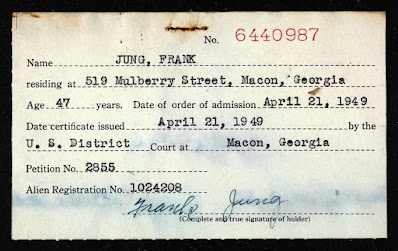
I recently discovered that my father had been issued an Alien Registration number in 1949. I do not know whether he had to carry it at risk of deportation if he did not have it if asked to present it to an authority.


6/5/20

Chinese Prostitution in San Francisco, 1870s-1910


A 1897 article in North American Review by Charles Frederick Holder* described the composition of the approximate 20,000 Chinese in San Francisco


The shocking finding that of the 2,500 adult females, 1000 are wives but the other 1,500 were in effect, slaves. They were here because they were kidnapped or tricked with promises of matrimony.  Below is a detailed description of a common method of deceiving young women to come to America.


The Pacific Mail Steamship Company which transported thousands of Chinese between Hong Kong and San Francisco in both directions was in on the fraud as it made considerable profit from tickets for the illegal women. To circumvent immigration obstacles, fake documents were created naming a woman as native born.


These women were sold at auctions to owners who profited by forcing them to work as prostitutes. 


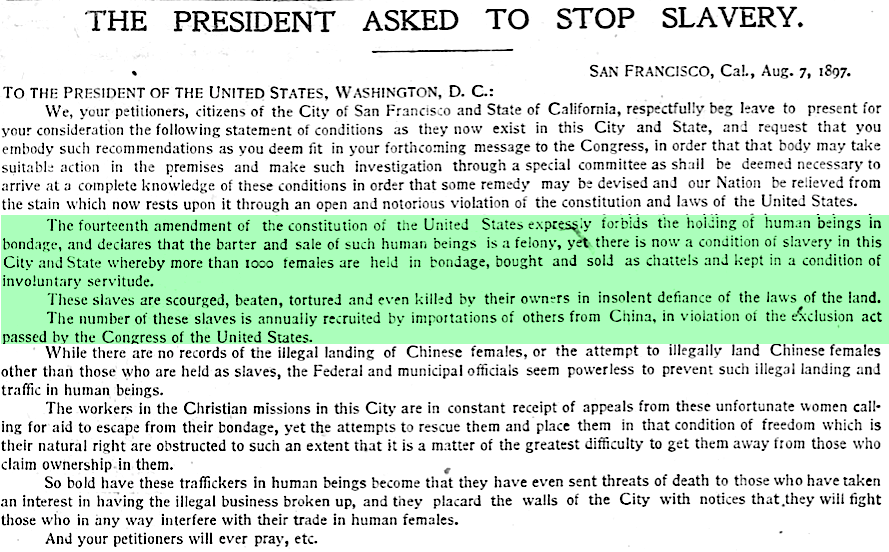
The statistics for earlier decades were even more alarming. In the 1870 census, there were 2014 Chinese women, and over half, 1,413, were prostitutes. Alarm over the high rates of prostitution led to requests for intervention by the President of the Unirted States.


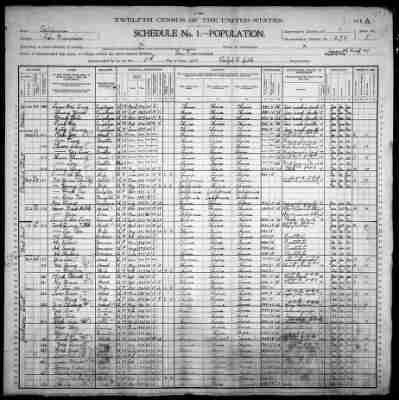
Below is a small sample of prostitutes in San Francisco listed in the 1900 U.S. Census.
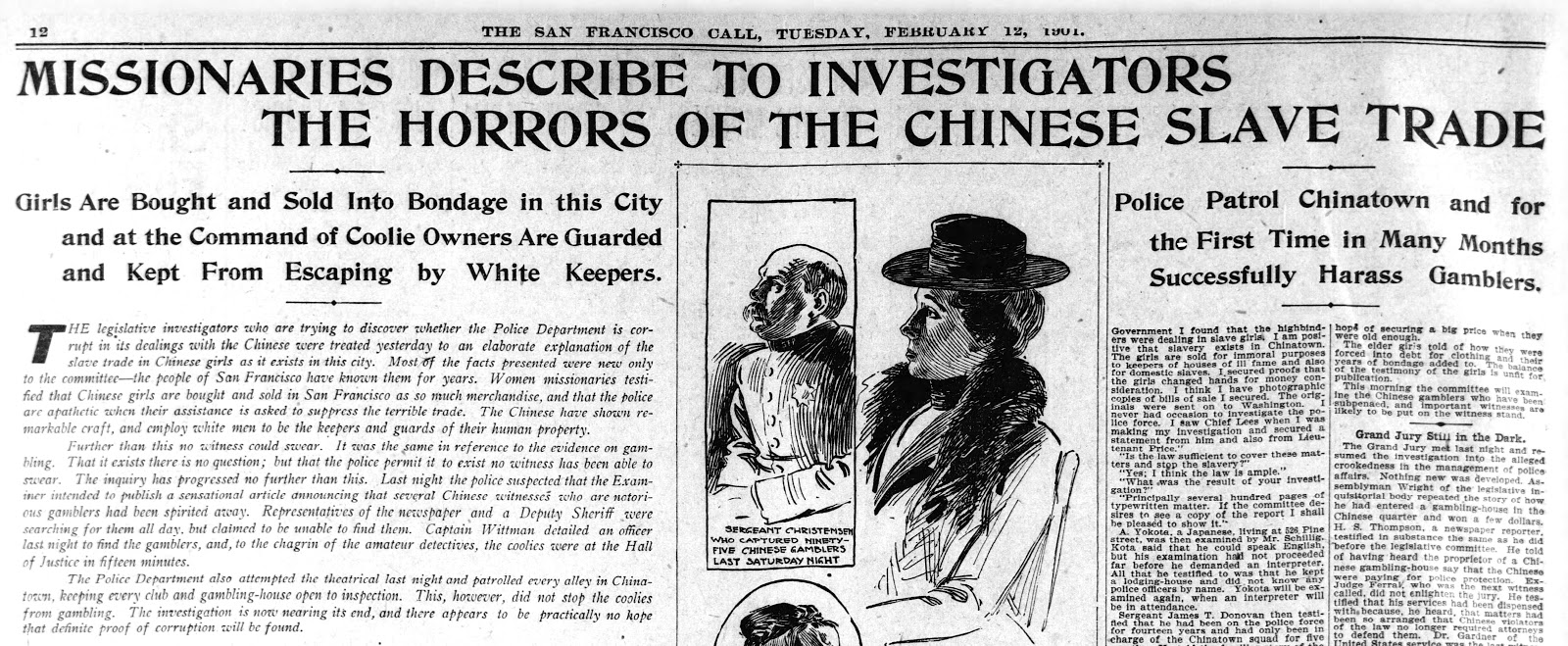
The San Francisco Call newspaper ran many articles describing the terrible living conditions of the prostitutes who were trapped without much hope of escape.
Missionaries and other social reformers were concerned about the plight of the prostitutes from both humanitarian and moral concerns. Their testimony was helpful to authorities and police in their efforts to curtail prostitution.
A mission house in Chinatown became a sanctuary for rescued prostitutes. Donaldina Cameron, a dedicated fighter, worked with the police in breaking into brothels and hiding them in the mission house. Now the mission house is named after Cameron, and it serves as a community center with ties to the nearby Chinese Presbyterian Church.

A popular adventure magazine of the period, Old and Young King Brady, often had fictional stories situated in Chinatown, including the rescue of Chinese slave girls from opium dens dramatically illustrated on the magazine cover.


*Charles Frederick Holder, the author of the 1897 article on Chinese prostitution in San Francisco was a remarkable "renaissance man" whose many interests and talents make him an improbable author on the topic of Chinese slavery. He was a naturalist, conservationist, and scholar writing over 40 books. Holder was an expert fisherman and pioneer of "big game fishing." He created the Tournament of Roses parade held in Pasadena on New Year's Day.


Koopmanschaap: Rise and Fall of A Labor Contractor

The end of slavery in 1865 presented a major problem for Southern cotton planters. In 1869 at a Memphis meeting of planters, a plan was made to recruit Chinese laborers to replace the slaves in cotton fields.  Cornelius Koopmanschaap, a well-known labor contractor from the Netherlands, stated that he could bring 30,000 Chinese to the South. He testified that Chinese were hard workers at low costs who had worked out well in other parts of the country, a claim that had mixed support as one Texan reported the Chinese were less productive than Negro workers.

Koopmanschaap's contract to provide Chinese laborers detailed the costs for emigration fees and transportation costs for bringing Chinese laborers from China by ship to San Francisco and by rail as far as the Missouri River. It also spelled out the contractual terms for work hours and conditions, clothing, housing, and food..


The newspaper in Newberry, South Carolina, placed a derogatory header, Price of the Pigtails, above the printed contract.


Koopmanschaap met with a government official in Washington in 1869 to gain approval for his plans. He emphasized that he was not bringing coolies or indentured workers but Chinese who came freely and accepted his contractual terms.


In addition to providing Chinese to planters in the Mississippi delta, Koopmanschaap also contracted to supply 1500 Chinese for Tennessee and Alabama. 

Success in bringing Chinese labor to all parts of the U.S. was not an easy achievement as Chinese men were reluctant to go to work in the East and Chinese women hesitated to go work in domestic family employment in the East.


Although white labor had strongly opposed bringing Chinese to the U.S., welcoming views were sometimes voiced as in an 1872 commentary in the Hickman, Kentucky, newspaper that doubted the fears that the country would be overrun by cheap Chinese labor.


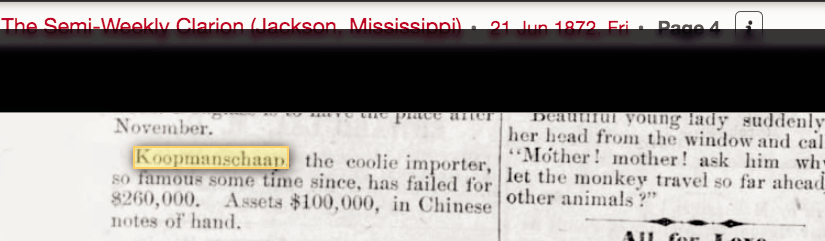
Despite all his efforts to provide Chinese laborers, Koopmanschaap went bankrupt in just 3 years with debts of $250,000 and only $100,000 in assets as reported by the Semi-Weekly Clarion newspaper of Jackson, Mississippi.

Evidence regarding how many Chinese he actually brought to the mid-South is lacking, but of those who came to Mississippi most, if not all, quit working in the fields and opened small grocery stores in black residential areas in small towns throughout the Mississippi Delta as well as in several towns in Arkansas across the Mississippi River.i