About Me

After a career of over 40 years as an academic psychologist, I started a new career as a public historian of Chinese American history that led to five Yin & Yang Press books and over 100 book talks about the lives of early Chinese immigrants and their families operating laundries, restaurants, and grocery stores. This blog contains more research of interest to supplement my books.

4/26/15

Colman’s Mustard and Chinese white cut chicken   白斬雞


The Colman brand of mustard is an iconic product with a long and celebrated  history in England. 

It is also a popular condiment among Chinese and as common as soy sauce in Chinese restaurants, which made me wonder how Chinese immigrants in America discovered or came to use mustard as a condiment, and whether they preferred the Colman brand.
Did they only discover it after coming to America or was it possible that they knew about it in China when the British came to control Hong Kong following the opium wars in the middle of the 19th century. Perhaps the British introduced mustard, or at least the Colman brand, to the Chinese.  Or did the Chinese already use mustard in their cuisine before the British came but adopted the Colman brand introduced to them by the British?

Some food for thought.

On A Personal Note

Sundays were a special day for our Chinese immigrant family for it was our one day of rest from operating our laundry during the rest of the week. It was the only time we could enjoy having a meal with the whole family, my parents and three siblings. 

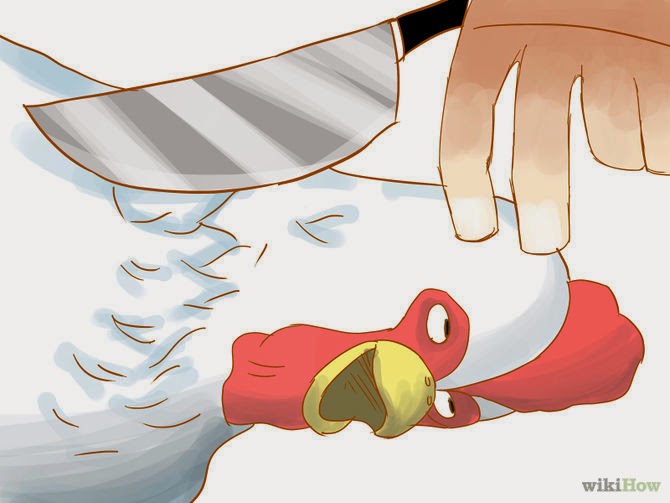
Mom would often buy a live chicken a day or two before Sunday and keep it in a small crate with wood slats.  I would “play with it” before Sunday morning when mom would grab it by the feet with one hand while holding a cleaver in the other.  Held upside down, the fowl would flap its wings desperately before mom deftly used the cleaver to ‘slit its throat’ and quickly drop it into a galvanized tin pail.  I can still ‘hear’ the sound of its toenails scratching against the pail as its life ended. After draining all the blood, mom would pluck its feathers before cooking it in a pot of boiling water for a few minutes.  I was only about 4 years old, but mom didn’t hide this process from me, or make any fuss over it so I was not particularly bothered watching how our Sunday dinner came to be.


It just seemed natural.  Mom was just doing what she did or saw done back in her Hoiping village in China. But thinking back about it, I am surprised that I was not at all bothered by it.

The fresh chicken was then poached, usually in a broth with cellophane-like chewy but delicious seaweed.  We kids would often fight over getting the “innards” (eggs, liver, heart, gizzards), which today you don’t get in the chickens from the supermarket. Mom gave us the best parts, slices of the white meat, while she and father would chew on the parts with bones.

We loved to dip our pieces of chicken in a dish of soy sauce first and then in a dish of mustard made by mixing Colman’s mustard powder with water.  This mustard was so spicy that if you used too much you would feel the top of your brain tingle or even feel numb for a moment or two. It was a scary, but also exciting, sensation.


One day I happened to read the label on the tin Colman container, or somewhere, how Colman mustard powder could be used as a foot bath for people with colds.  I was horrified to learn that something we loved to put on our chicken was the same stuff that other people applied to their feet!  I never heard of Chinese using it that way so I inferred that only non-Chinese were so barbaric.


3/26/15

Donaldina Cameron, Rescuer of Chinese Sex Slaves

Most accounts of victimization of Chinese involve white perpetrators.  However, it must be recognized that sometimes it was other Chinese who ruthlessly exploited the plight of early Chinese immigrants to their own advantage. For example, the shortage of Chinese women immigrants which was exacerbated by the Chinese Exclusion Acts that started in 1882 provided an opportunity for profit from Chinese women forced into prostitution.

In San Francisco, Donaldina Cameron of the Presbyterian Chinese Mission became a legendary crusader who devoted her life to locating and rescuing, at great risk to her own safety, countless Chinese women who had been trapped into becoming sex slaves.

A description of her role was published in 1922 in a Portland, Oregon, newspaper when she made a visit there. The sensational headline highlights how Chinese used 'dark and tricky' ways to enslave young Chinese girls.

The journalist begins his account with a quote from Bret Harte that reinforces this depiction of the "heathen Chinee"


The article summarizes two cases of young Chinese women that Donaldina Cameron snatched from the clutches of their slave masters.


The mission house in the heart of San Francisco Chinatown where Donaldina Cameron hid and protected rescued girls and women is named in her honor. Its function has changed since her time and serves as an active community resource center serving Chinese of all ages and backgrounds, especially youth, elderly, and victims of domestic abuse.

Although her work was in the San Francisco Chinatown, Miss Cameron is buried in southern California. http://chineseamericanhistorian.blogspot.com/2012/04/ching-ming-remembrance-in-los-angeles.html


2/21/15

Chop Suey Before Li Huang Chuang's 1898 Endorsement

One popular "legend" about chop suey is that the dish was unknown in America before a Chinese chef created it for Viceroy Li Huang Chuang during his visit to New York in 1898. However, evidence exists that chop suey was already known in America before his diplomatic visit. For example, a 1892 article in the San Francisco Chronicle described the dish, chow chop suey, as a popular dish at Chinese restaurant banquets.


Before Li Huang Chuang was introduced to chop suey, judging from grocery store ads the dish was already known in America. A 1895 grocery store ad in Centralia, Wisconsin offered a 16 oz. package of vegetable chop suey for 35 cents.


An advertisement in 1898 for the A & P grocery chain store in Laredo, Texas, offered pork cubes for chop suey for $1.89 lb.
Clearly, these ads show that chop suey was already familiar to Americans prior to Li Huang Chang having his 1898 chop suey dinner.

 
Of course, because the celebrity status of Li Huang Chuang attracted large crowds to his public appearances in New York and Philadelphia, newspapers across the country publicized his visit and his approval of chop suey, which doubtless increased American curiosity and acceptance of this 'toothsome dish.  

However, despite its  growing acceptance, chop suey was mocked by non-Chinese, as evidenced in the 1900 doggerel, that showed suspicion of this mystic dish, so popular with John Chinaman. It questions what ingredients are in chop suey and suggests that it might contain birds and birds’ nests or even powdered dolphin’s fin! 

By the 1920s, chop suey was winning the stomachs, if not the hearts, of non-Chinese.  Mazola, a brand of cooking oil,  had ads that offered a recipe book for only 10 cents which included a recipe for chop suey that purportedly was “as the Chinese make it.”


11/30/14

Was there a Chinese "slave" in pre-civil war Virginia?

Historian Krystyn Moon traced the story of Tom Jefferson, a Chinese boy purchased in Canton in the mid 1850s by a Captain of a clipper ship that sailed from China to America.  He presented the Chinese boy, along with a chimpanzee, as part of his wedding gifts to his daughter in Alexandria, Virginia.

Moon discovered more details about the life of the boy, given the American name, Tom Jefferson.


Jefferson became a machinist, probably working for the Orange, Alexandria, and Manassas Railroad, and later for the Southern Railroad.  Interestingly, the 1860 census taker initially listed Tom's  race as “C” for Chinese but then he crossed it out and put “W” for white.  He did not marry or have descendants, dying from a stroke in Alexandria in 1899.


11/15/14

What Did Early Chinese Immigrants Get Fed Crossing the Pacific?

The accounts of the month-long journeys of Chinese immigrants sailing from Hong Kong by steamships to North American ports in the late 19th century tell of crowded quarters in steerage, but do not give much detail about what food was provided, or its quality and quantity.  The sketch below of Chinese passengers on the S.S. Alaska of the Pacific Mail Steamship Company shows the austere "dining space" in the steerage deck.

One newspaper article reprinted in the Louisiana Democrat in 1889 revealed one steamship company's description on this topic, although it may not be entirely truthful. A spokesman for the Trans-Pacific steamers described the meals as consisting mostly of rice, a variety of beans, some orange peel as a relish, dried fish, occasional dried abalone as a dessert, and "chow-chows" defined as different sauces.  For a trip of 30 days, the estimated cost to feed one passenger was $1.18. He bragged that "immigrants get as good food on shipboard as they get at home."

revised 11/16/20

10/17/14

Did the Chinese have equivalents of Columbus' "Santa Maria, Pinta, and Nina"?

       As a school kid, I was taught that Columbus sailed across the Atlantic with three ships, the Santa Maria, Pinta, and Nina.  But what do we know about the vessels that brought the Chinese immigrants of the 19th century to North America?  I certainly learned nothing about this in school.  There is much historical research about what happened to Chinese once they crossed the Pacific to reach North America, but detailed information about the operations of the ships that transported them has been ignored, as if this process was unimportant.  

      Fortunately, a scholar in Hong Kong, Elizabeth Sinn, published a monumental work last year, Pacific Crossing, that fills this gap admirably. It is the most fascinating and enlightening book I've run across in recent years about Chinese immigration to North America. Scholarly, but highly readable, this masterpiece by  Elizabeth Sinn examines the huge economic and social impact of the business of transporting immigrants back and forth on ships between China and North America.  These developments, she holds, helped transform Hong Kong into its significant place linking the East and West.
     Sinn coins the term, in-between places, to describe the transitory and fluctuating domiciles of many immigrants who were neither here nor there for long periods.  She not only details the economic and trade profits of shipping human cargo to and from China, but also material goods including gold, granite, opium, flour, sugar, and Chinese food and spices.  She provides rich details of the traffic in prostitutes and slave girls as well as the transport of bones of Chinese who died overseas.

8/10/14

A Chinese Smuggling, Opium, and White Slave Ring Operation

           News about Chinese immigrant men that involved opium, smuggling, gambling, and sexual liasons with white women were sensational stories in the popular press from the late 19th well into the 20th century. When a Chinese merchant, Charles Sing, was murdered in Chicago in 1913 in an apparent robbery, a larger story unfolded. During their search of his living quarters,  police found a “black book” listing agencies for conducting opium sales that apparently belonged to a Chinese official involved in a smuggling ring. It contained records of Chinese smuggled across borders into the United States. Police think that the network of cities comprises a tunnel for hiding the smuggled Chinese.


In addition, they discovered more than 20 letters signed by white girls that led police to believe they had uncovered a “white slavery ring.”  The newspaper report failed to describe what the letters contained but suggested the contents would lead to convictions related to the Mann white slave act. One of these letters was signed by Emma Davis, the sister of Mrs. Alice Sing, the white wife of the dead Chinese merchant, currently in a hospital unable to speak due to some type of “hypnotic paralysis” or self-inflicted spell. Her father said his daughter worked in a Chinese restaurant in Kansas City, which led her to become interested in Chinese through work at the mission in Kansas City Chinatown where she met Charles Sing, married him, and moved to Chicago with him.


7/22/14

Give Chinese Wisconsin...and...


In the spring of 1918, news was reported that a substantial portion of Chicago's Chinatown will invade Munro and Juno counties for the purpose of farming certain marsh regions, stating "the Chinese will desert the laundries of the Windy City to brave the cold and raw spring of chilly Wisconsin." The objective of the yellow men will be agriculture. They intend to raise humble "Spud," the odoriferous onion, the carrot, the radish, and  other American vegetables before the summer has progressed far.  

Daniel Burkey, a Tomah land dealer closed contracts for several hundred acres of land with Hip Lung, the unofficial "mayor" of Chicago Chinatown. All leases and options are in the name of Hip Lung and the new organization will be incorporated as the "Chinese American Farming Company." They plan to give each farmer 20 acres.  The 1918 crops will be potatoes, onions, celery.  Chinese will be furnished with farm implements, seed, and horses but they will be required to hire their own labor. 

Hip Lung proclaimed, "Give the Chinese Wisconsin for farming purposes and the rest of the country can turn to the business of beating Germany!"  Score one for Chinese enterprise!

7/15/14

Frequency of Ching Chong and Chinaman's Chance in Books

The frequency of occurrence of racially charged terms such as "ching chong" might be a reflection of societal attitudes toward Chinese.  One quick, but very rough, gauge of anti-Chinese sentiment might be historical trends in the occurrence of such terms in books.

Google's Ngram viewer provides such data, but it does not examine the context of the occurrence, only raw frequencies. Nor does it examine newspapers or other media. So,with that warning, here is a chart for occurrences of "ching-chong."  The derisive phrase has shown a consistent pattern rising slowly from the 1930s to mid 1960s and then rising sharply to the present.

For comparison, "Chinaman's chance" is included.  It was not an epithet but rather a metaphor for a variety of 'lost causes' or hopeless situations such as that which Chinese suffered from racism.  Its peak frequency was in the 1930s, perhaps due to the Great Depression, dropped in the 1950s, a period of prosperity. It peaked again in the 70s and then has declined and leveled off as of 2000.

In summary, 'ching chong,' a mocking taunt, has increased over the last 70+ years. How well it can serve as a barometer of anti-Chinese feeling is ambiguous and it needs to be compared with other indicators.  In contrast, the metaphorical 'Chinaman's Chance' has fluctuated perhaps with the hopeful or hopelessness of the era.

Note: These terms were used prior to 1900, but their relative frequencies were too low to show up on the graph in comparison to the more recent years.  In contrast, two other terms, Chinee and Chinaman, were not graphed because their relative frequencies were far greater than ching chong and Chinaman's chance.


At the bottom of an actual Ngram chart (not on this jpeg image), if you click on the years, you can see excerpts from books showing the actual context of the term.

One other note: the high frequency of "Chinee" was largely due to the popularity of Bret Harte's classic  1870 "Heathen Chinee" poem and to a lesser extent, "Jolly Chinee" fairy tale children's stories by E. Veale (1896).


7/12/14

Chinese to the South 2. But Will The Chinese Come?

In 1869, interest in bringing cheap Chinese labor to many parts of the Deep South was growing rapidly. They were sought as cheap labor for work in cotton fields, farms, rice fields, and construction of railroads and canals.

But how likely would it be that the Chinese would come to a region where there were so few other Chinese?  If they were in California, would they be willing to leave Chinatowns to go to places where they would be among the very few Chinese?

Although the views of a Chinese merchant in New York, Choy Chew, were those of only one individual, he did raise some important factors that might affect the success of recruiting Chinese for the South that made him skeptical.

Charleston Daily News, 6.19.1869
In a more extensive 1869 report in the New York Herald, reprinted in the Georgia Weekly Telegraph, Choy Chew argued that Chinese would be reluctant to go South because "Chinamen like to die at home," alluding to the fact that San Francisco is much closer to their homeland in China. They "want to make all the money they can and then return" and therefore  "do not care to go very far away from San Francisco if they can help it"

Georgia Weekly Telegraph, 1869
Chew did concede that how well the first Chinese that went to the South were treated would be a big determinant of whether "millions will go there."