About Me

After a career of over 40 years as an academic psychologist, I started a new career as a public historian of Chinese American history that led to five Yin & Yang Press books and over 100 book talks about the lives of early Chinese immigrants and their families operating laundries, restaurants, and grocery stores. This blog contains more research of interest to supplement my books.

7/12/14

Chinese to the South 2. But Will The Chinese Come?

In 1869, interest in bringing cheap Chinese labor to many parts of the Deep South was growing rapidly. They were sought as cheap labor for work in cotton fields, farms, rice fields, and construction of railroads and canals.

But how likely would it be that the Chinese would come to a region where there were so few other Chinese?  If they were in California, would they be willing to leave Chinatowns to go to places where they would be among the very few Chinese?

Although the views of a Chinese merchant in New York, Choy Chew, were those of only one individual, he did raise some important factors that might affect the success of recruiting Chinese for the South that made him skeptical.

Charleston Daily News, 6.19.1869
In a more extensive 1869 report in the New York Herald, reprinted in the Georgia Weekly Telegraph, Choy Chew argued that Chinese would be reluctant to go South because "Chinamen like to die at home," alluding to the fact that San Francisco is much closer to their homeland in China. They "want to make all the money they can and then return" and therefore  "do not care to go very far away from San Francisco if they can help it"

Georgia Weekly Telegraph, 1869
Chew did concede that how well the first Chinese that went to the South were treated would be a big determinant of whether "millions will go there."


7/7/14

Chinese To The South 1. Recruiting

Chinese immigrants who came in large numbers to California, attracted by the discovery of gold in the Sierras in 1849 initially stayed mainly on the Pacific coast. As opportunities in mining soon declined, thousands of Chinese laborers were recruited to help build the Central Pacific section of the transcontinental railroad. 
Upon its completion on May 10, 1869 at Promontory Point, Utah, these Chinese were suddenly without work. Labor contractors recruited many of them to work on other regional railroads as in Texas, possibly, Alabama, and in Mississippi.


While some workers headed back to the Pacific coast, others stayed in the rocky mountain area or quickly edged their way into the midwest, south, and east coast. This relocation of Chinese was facilitated by the search for cheap, but reliable, labor. The transcontinental railroad was completed in May of 1869, and before the summer ended, Southern planters had developed plans at a convention in Memphis to bring Chinese from as far away as China to replace the black slaves in the cotton fields.


Newspapers announced any sightings of Chinese headed toward the South. One planter in 1869 was quoted as saying that arrangements had been made to bring "some Chinamen" to Southern Mississippi due to the "negro exodus" from the South.  Another article noted that an agent from a St. Louis labor contractor was arranging for a supply of Chinese labor to work in Alabama.


Accurate evidence on the number of Chinese brought to the South is difficult to obtain. For example, the 1880 Census indicated there were 467 Chinese in Louisiana which is somewhat at odds with a 1873 New Orleans newspaper report that 220 Chinese were brought to Louisiana and 55 to Arkansas in 1869. There was a much larger discrepancy with the 1880 Census count and the claim by Chinese labor contractors of 2,000 Chinese.


Not having had direct contact with Chinese immigrant labor, it is not surprising that efforts had to be made to persuade some planters that the Chinese would be a valuable source of cheap and reliable labor. Newspapers published praise of Chinese workers to reassure the skeptical.


The article went on to say that "It remains to be seen how John Chinaman will be received in the South. The experiment is to be made on a scale worthy of the great national question of labor.  Five hundred Chinamen have been landed or will be landed at Memphis in a few days, and then will be scattered through the large and small towns of the South...Ir remains to be seen how the Oriental will stand the stern Anglo Saxon southern test of labor, capacity and availability."

Only 4 years later, in 1873 Chinese laborers from Indianapolis moved to Augusta, Georgia to work on the construction of the Augusta canal.  The Augusta Chronicle on Nov. 5, 1873 confirmed that 25 "Celestials" (as they referred to Chinese then aside from "Chink" and "John Chinaman") had arrived the previous morning via the Georgia Railroad. A labor contractor, Mr. E.L. Rider, himself half Chinese, arranged to bring them from Indianapolis where they had been working to help expand the Augusta Canal.

Curious onlookers gathered as most of them had never seen a Chinaman before. Another 30 were on the way. How many, if any, of these men stayed in Augusta is unknown, but it seems plausible that some of them did. If so, they would have been among the few Chinese in Augusta. where eventually there were several hundred Chinese including women and children, making it the largest Chinese community in the southeast.

One forecast in the Macon, GA. Weekly Telegraph on May 21, 1869 predicted that legal barriers would not be created to stem the "overwhelming floods" of Chinese that were certain to come to the South, immigrants who would not be content to work on plantations.


 An economic depression hit the country in the 1870s and fears that cheap Chinese labor would deprive white Americans of work combined with xenophobic reactions to these foreigners with different customs and language generated growing opposition against Chinese laborers.

In contrast, less vocal advocates of the use of Chinese labor such as a writer for the Augusta Chronicle tried to reassure the public that the size of the threat of a handful of Chinese was minimal.


The 1869 prediction proved both right and wrong. Large numbers of Chinese did come to the U. S., as forecast, but the prediction that no legal bars would be imposed was dead wrong.  The Chinese Exclusion Law passed in 1882, and would last until 1943, drastically curtailing Chinese immigration for decades.


6/9/14

Fong Chun Shee, Procuress of Chinese Sex Slaves, 1887

     The Chinese Exclusion Law of 1882 created an unintended opportunity for unscrupulous exploitation of young Chinese women who were forced into lives of prostitution.  Chinese laborers, unable to bring their wives from China and blocked from marrying white women by anti-miscegenation laws, provided a large demand for the illicit sex trade. There were many accounts of girls in China sold into slavery, kidnapped, or deceived into coming to Gold Mountain where they were forced to become prostitutes.

On November 23, 1887, a Chinese woman named Fong Chun Shee was accused of bringing three young Chinese girls for "immoral purposes." She allegedly bought the young girls, who came from the poorest level of society, from their mothers and supplied the girls with false identities.

Fong Chun Shee, Accused Procuress

Immigration officials found incriminating letters in a tin box containing letters instructing the three girls how to answer the questions that they would receive when they reached San Francisco.  They memorized details of false identities that claimed they were older than they actually were and that they were coming to the U.S. to join their husbands whom they had married back in China.  However, when confronted with the letters, the girls confessed that the personal information they gave was false.  

At the trial on Jan. 10, 1888, One girl, Lee Sing Tsoy, testified her mother sold her for $620 to the defendant,  Another girl, Chung Sing Chin stated she had been sold for $420, and all her expenses were paid by the defendant with the understanding she would become a prostitute in this country.  


Fong Chun Shee, despite the strong evidence against her, was not convicted as the jury was not persuaded in two trials, and it appeared unlikely that there would be any further attemtp.  The slave girls who testified against Fong Chun Shee were deported back to China.


6/3/14

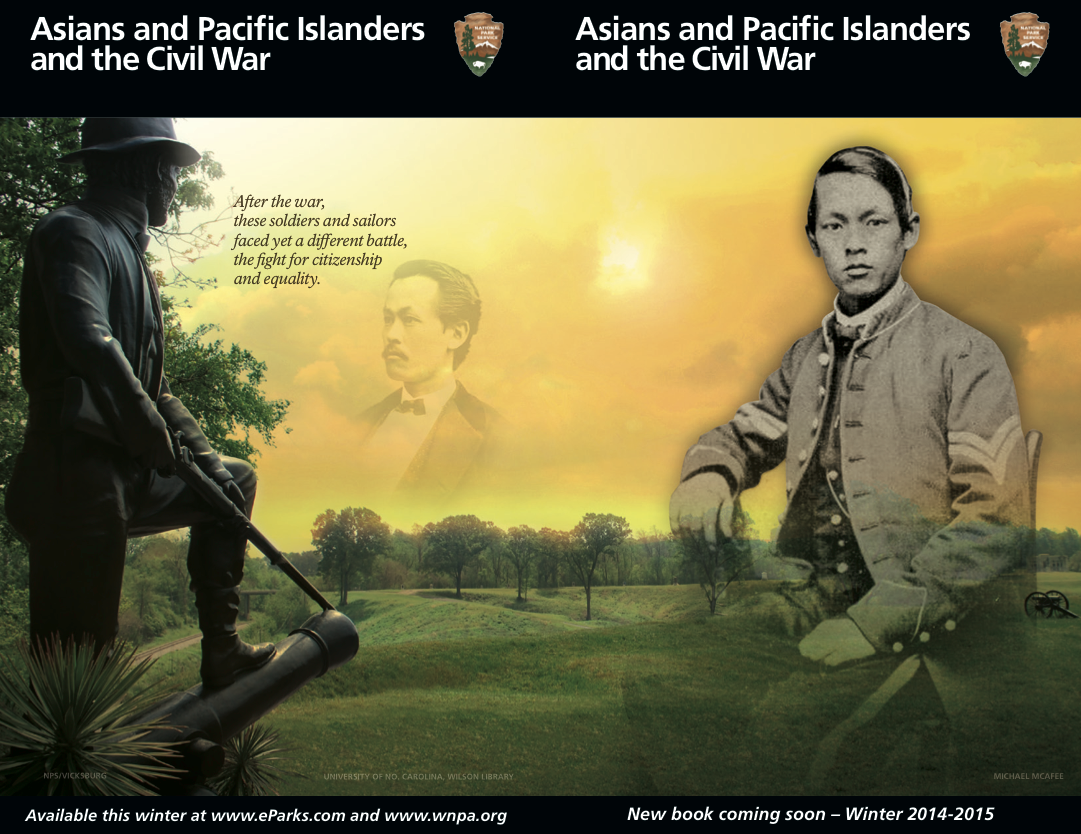
Asians and Pacific Islanders and the Civil War: National Park Service Book for Winter 2014-15

The participation of Asians and Pacific Islanders soldiers in the Civil War is not generally known. This winter, the National Park Service will publish a book to recognize these few men who fought in the Civil War on both sides of the conflict.


5/31/14

The Mandarin Cafe of the 1930s in Bakersfield


Gilbert Gia, a local historian of Bakersfield, California, shared nostalgic reflections about the the Mandarin Cafe, a Chinese restaurant and night club owned by Earl and Alice Wong that flourished briefly from the mid to late 1930s as seen through the eyes of Carlye Nelson, a musician who performed in the 4 man band that played for dances nightly at the Mandarin.


"Earl Q. Wong, was born in China, married Alice Mar in 1919, and 
in the early 1920s the family came to Bakersfield. In 1923 the Wongs 
bought a residential lot near today’s downtown  Bakersfield in the 
Hudnut tract near 27th and O Streets."

"Earl Wong’s son Delbert (who would go on to be the first Chinese American
to graduate from Stanford Law School, and the first Chinese American to be 
appointed to the bench in the continental United States and later serve on the 
Superior Court) recalled that by 1926 his father was “just getting started in
his Lincoln Market.”  Explaining why or how his father got into the cafe business, 
Delbert noted that "I have a vague recollection that the reason my father went into
the night club business was that he had extended credit to the previous owner, who 
was a customer of the Lincoln Market, and my father had to take over the 
Mandarin when the customer was unable to pay."

"In 1934 Earl Wong bought the Lido Café from Joseph Cinelli and 
Angelo and Julia Pierucci, changed the name to the Mandarin Café,  and 
with his wife went into the nightclub business in 1935. 

According to one of the musicians, Carlye Nelson, who played at the 
Mandarin and later performed with the Glenn Miller Band later during WWII:

“We played seven nights a week from 9 PM 'til two, pl us a Friday 
afternoon show rehearsal. Our four-piece orchestra consisted of a 
trumpet (Laurie), piano (Mike Richmond), drums (Gifford), and me on the 
sax, and I doubled on the violin. Word of what to expect in music at 
the local clubs circulated among show performers, and we had an 
excellent reputation. We were also popular with the local dancing 
customers, and although the dance floor was small, it saw a lot of 
action. The floor was painted in a spider web motif, and in the center 
of it was a glass lens that had a spotlight under it.

“The mistress of ceremonies was a more-or-less permanent girl who 
had a taste for alcohol and who could sing as well as “M.C”. Besides 
her salary, the club gave her a discount on the drinks she consumed. 

“The mandarin was a good place to work. The bartenders and cooks 
were Chinese. The cooks--who lived in the basement--were pleasant but 
would tolerate no outsiders in their kitchen. At first Mrs. Wong would 
get coffee for us, but later they put the coffee urn where we could 
reach it ourselves without bothering the cooks. If we wanted to eat at 
the club, we could get it for half price. 

The Mandarin Café and Night Club closed in 1938 but reopened in 
1939 under new ownership as Club Cathay. In later years it was the 
Nanking Café. Today a parking structure stands where dancers once spun 
under a "cobweb" ceiling. Also gone today is a word that was at one 
time commonly understood.


5/14/14

Chinese To The South 4. Will They Stay?

       It is no surprise that the early Chinese immigrants in the middle 19th century arrived and mostly settled on the west coast and that some moved toward the Rocky mountains when Chinese were recruited to work on the building of the transcontinental railroad in the mid 1860s. What is not so easy for many to comprehend is why and how small numbers of Chinese gravitated to the Deep South, especially Mississippi and Georgia, by the 1870s.
 Southern solution for  Chinese :problem'
       One key factor was the end of slavery in 1865, which posed a serious threat to the availability of cheap labor for the South.  Many freed slaves became part of the Great Migration to the large cities of the North such as Chicago.  At the Memphis Convention of cotton plantation owners from several states in July, 1869, a proposal was made to recruit Chinese workers, especially because with the recent completion of the transcontinental railroad in May, 1869, many Chinese were no longer needed in railroad work although some did find work on smaller regional rail lines.  Chinese workers were viewed as a source of cheap labor to replace blacks in the cotton and rice fields of the South. In Augusta, Georgia, Chinese in the north were recruited to fill the need for cheap labor to help build the Augusta Canal to supply hydroelectric power for their textile mills.
New York Times, Aug. 17, 1869
           Other parts of the South also showed interest in recruiting Chinese labor.  Savannah was receiving 14 Chinese to work on rice plantations across the Savannah river in South Carolina.
May 21, 1869


1874. Chinese coming to Savannah.
      In addition, there were some objections among townspeople about bringing Chinese.  Fears that hordes of Chinese would overrun communities arose such that Augusta recruiters tried to reassure residents that there were "not more than thirty Chinamen there."
Augusta Chronicle, 1886
     Blacks, who were likely to be displaced by Chinese, showed both curiosity and hostility toward these foreigners when they first arrived in their Chinese attire, queues, and strange sounding language. An editorial in a Vicksburg, Mississippi paper reflecting on the expulsion of Chinese from California in the 1880s. observed that if negroes are duped to make an exodus to the frozen North, the South will have the Chinese to replace them.


        However, once Chinese came to the South, they did not take well to plantation work in the fields, and generally preferred to open their own businesses, mostly grocery general stores and hand laundries. However, they were not well accepted and were sometimes victimized by assaults and robberies. In 1900 whites in Rosedale, Mississippi, ordered Chinese merchants to leave the country within five days, leading the Chinese to seek a meeting with the state governor who promised to protect their rights.

Rosedale, MS. crisis with Chinese merchants. Aug. 16, 1900  
Atlanta, 1913

Augusta, Georgia Sept. 17, 1910


5/12/14

Connections Between the Soong Sisters, a Chinese who served in American Civil War, and Macon, GA.

        It might seem very unlikely for there to be connections between Macon, Georgia, with the Soong sisters, arguably the most influential trio of sisters in modern world history, and with a Chinese who fought for the South in the American Civil War.
        Cao Zishi, a 14-year old Chinese boy adopted by missionaries in China was brought to the American South in 1859 just before the outbreak of the Civil War. Adopting the American name of a benefactor, C. K. Marshall, he volunteered for the Confederate army although it is unclear whether at his young age he actually engaged in combat or was just part of the support personnel. In an interview in 1905, Marshall's son mentioned that Marshall had lived near Macon, Georgia. After the war, Marshall attended college in Tennessee and then returned to Shanghai as a missionary in 1869, and he founded a school that later became Suzhou University.
Excerpt from June 8, 1905 interview in Buffalo Express. Source: http://bluegrapychinese.blogspot.com

        During his stay in Shanghai, Marshall met Charlie Soong (1863-1918), another Chinese who lived in the American South for many years. He had studied theology in Wilmington, North Carolina, as well as at Vanderbilt University in Nashville, Tennessee. After his return to China, Charlie Soong made a fortune selling Bibles, funds that he used to help Sun Yat Sen's revolution in 1911.
        The common background of Soong and Marshall with Christian religion in the American South might have led to Soong and Marshall becoming acquainted in Shanghai.  Marshall, in fact, became a tutor for the Soong daughters teaching them rudiments of Chinese characters and some of the classics.

Charles Jones Soong

         Soong met and married Ni Kwei-tseng, a well-educated Chinese woman who was a devout Christian from a prominent family. They were ahead of the times and wanted their daughters to be educated, but China did not have colleges for women so they turned to the United States.   Due to his own positive experiences in the American South, Soong chose to send his three daughters to the American South for their schooling.   He asked W. Burke in Macon, Georgia, a former classmate at Vanderbilt who became a Methodist missionary, to accept them as his wards.

Macon Telegraph newspaper announcement regarding 3 Soong sisters in Macon, 1908
.
       The two oldest daughters enrolled at Wesleyan College for Women in Macon.  However, Macon seemed to have been a bad choice for 13-year-old May-Ling as she was not allowed to attend a white middle school in Macon because she was not white.  This actually worked out to her advantage as she received a better education from a private tutor than a public school could provide.

Macon Telegraph, 1910.

        The three Soong daughters would later have great influence in China's, and world history.  The oldest daughter, Ai-Ling married H. H. Kung, a wealthy man, and finance minister of China.  Ching-Ling, the next oldest, married the leader of the Chinese revolution, Sun Yat-Sen, and the youngest, May-Ling, married Chiang Kai-shek, the first President of the Republic of China.  

Soong sisters

    It is of note that in 1944  Charley Soong was honored in Wilmington, North Carolina, where decades earlier he converted to Christianity.

"The small granite monument reads: “Charlie Jones Soong, father of the famous Soong family of modern China, was converted to Christianity in the old Fifth Street Methodist Church, which stood on this site. He was baptized on Nov. 7, 1880, by the Rev. T. Page Ricaud, then pastor. One of his six children, Madame Chiang Kai-shek, whose Christian influence is world-wide, is the wife of China’s devout generalissimo and president. Erected in 1944.”


revised 11.17.20


4/8/14

Assimilation of Chinese Children in New Orleans, 1912


A reporter for the Times-Picayune newspaper in New Orleans analyzed the children of Chinese immigrants in 1912. He found, to his surprise, that their parents were raising their children to fit American fashions, language, and customs. He expressed amazement that despite coming from a culture several thousands of years old the Chinese could so quickly assimilate in one generation. Obviously, he held a strict hereditarian view and was unaware of, or rejected, the behavioristic revolution of John Watson that would come to dominate American psychology for the next 50 years or more.


                        In recognition of his misconceptions, the journalist did allow that one Chinese mother                         spoke English as well as he did, if not a bit better.

Nonetheless, he could not avoid noticing and emphasizing the "solemn black slanting eyes" of the Chinese babies gazing into his admittedly "strange ones."

It seems the reporter was having more trouble accepting the Americanized Chinese children than the latter were having in acquiring the customs of the children around them in New Orleans.

3/22/14

Chinese Labor Contractors


     Before the Chinese Exclusion Act of 1882 prohibiting the entry of Chinese laborers to the U. S., thousands of Chinese were recruited by labor contractors, both non-Chinese and Chinese, to come work on railroad construction, mines, lumber camps, and other labor-intensive work. It is difficult to underestimate the importance of their role in bringing large numbers of Chinese across the Pacific to work where they did not know the language and customs. Chinese laborers recruited by a labor contractor would be transported to distant sites across the U.S. without their need to know the language, customs, and geography of their work sites.
    Below is an ad in 1870 for Sisson, Wallace & Co.,  a general agent company dealing in Chinese goods, groceries, and all kinds of family supplies in San Francisco. It also promoted the recruitment of supplies of Chinese labor in areas of northern California and Nevada, in particular to the Central Pacific Railroad (CPRR).  In 1866, it began to recruit Chinese laborers for the CPRR and was one of the largest contractors. They would hire a Chinese contractor to handle the payments to the workers and arrangements for their room and board.

    
    Another prominent non-Chinese labor contractor was Cornelius Koopmanschap, a Dutch immigrant who began recruiting over 30,000 Chinese laborers in 1861 for railroad construction. By 1870 he expanded his business to bring Chinese labor to the South to work on farms and plantations in Texas, Georgia, and Louisiana but his efforts in 1869 to bring Chinese as replacements for African Americans on cotton plantations failed by 1875.  Just before the 1882 Chinese Exclusion Act, he brought several thousand Chinese to work on the Southern and Northern Pacific Railroad construction.
    Chinese also served as labor contractors, and having the advantage over whites of being fluent in the Chinese language, were effective recruiters. Ah Quong in Reno, Nevada was an important recruiter who worked with white labor contractors to bring workers for the CPRR.
    In the Pacific Northwest, Chin Chun Hock was a very successful labor contractor for railroads and lumber camps, establishing the Wah Chong Company in Seattle in 1868 importing and manufacturing goods including sugar, tea, rice, cigars, opium (legal at the time), and fireworks.  In 1873, 20-year-old Chin Gee Hee, became a junior partner until 1888 when Chin Chun Hock bought his share of the business.  

      
       Chin Gee Hee then focused on being a labor contractor with his Quong Tuck Company which supplied construction workers to railways (the Great Northern Railway, the Seattle and Walla Walla Railroad and Transportation Company) and other construction projects in the Pacific northwest.


Chin Gee Hee, a Seattle labor contractor, in his office (1904).

       Chin Gee Hee returned in 1904 or 1905 to China, where he was the entrepreneur behind South China's first railway known as the Sun Ning Railway Company funded with $2.75 million he raised mainly from Chinese emigrants to other countries.
       In central California, Ah Louie (his American name) opened a store in 1874 in San Luis Obispo that had many services for Chinese immigrants.  It was a grocery and general merchandise store that also served as a bank, post office, medical herb shop, and gathering center. 

Most importantly, as a labor contractor, he was the foreman and employment agent of all the Chinese who worked on the Pacific Coast and Southern Pacific Railroads and later he was in charge of recruiting Chinese to work in the quicksilver mines near Cambria, California. His store building is preserved as California Registered Historical Landmark no 802, one of the last signs of a small Chinatown that is now virtually entirely gone.  Recently, archeologists have found Chinese artifacts on the site.


3/21/14

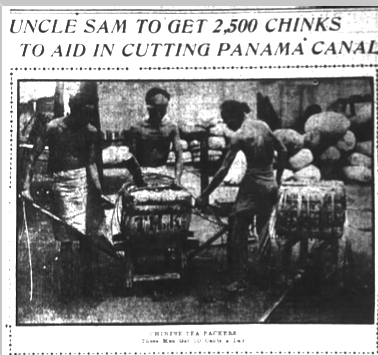
U. S. Getting 2500 "chinks" to work on Panama Canal


Chinese laborers were recruited to provide cheap labor in many parts of the world in the 19th century including Panama when railroads and the canal was built at the turn of the 20th century. A 1906 Atlanta Constitution article explained the procedures and policies for recruitment, treatment, and payment of the 2500 Chinese initially wanted to help dig the Panama Canal.

The tenor of the article is that the U.S. will be careful to be truthful in their recruitment procedures, making sure that each recruit fully understands the nature of the work, the living conditions, and what they will be paid.


However, the statement that each coolie will "be thoroughly scrubbed" suggests a condescending attitude that may indicate the men will not be accorded respectful treatment in other ways. Indeed, the preparation for their medical exam involves 100 men at a time coming into a hall "clad only in a piece of string and his paper tag."


The article describes and justifies the very low wages that will be paid on the grounds that they will make more than they would if they stayed in China. It also expressed concern about bringing too many Chinese because of their propensity to form unions, and the danger of strikes occurring which would impede the building of the canal.