About Me

After a career of over 40 years as an academic psychologist, I started a new career as a public historian of Chinese American history that led to five Yin & Yang Press books and over 100 book talks about the lives of early Chinese immigrants and their families operating laundries, restaurants, and grocery stores. This blog contains more research of interest to supplement my books.

4/8/14

Assimilation of Chinese Children in New Orleans, 1912


A reporter for the Times-Picayune newspaper in New Orleans analyzed the children of Chinese immigrants in 1912. He found, to his surprise, that their parents were raising their children to fit American fashions, language, and customs. He expressed amazement that despite coming from a culture several thousands of years old the Chinese could so quickly assimilate in one generation. Obviously, he held a strict hereditarian view and was unaware of, or rejected, the behavioristic revolution of John Watson that would come to dominate American psychology for the next 50 years or more.


                        In recognition of his misconceptions, the journalist did allow that one Chinese mother                         spoke English as well as he did, if not a bit better.

Nonetheless, he could not avoid noticing and emphasizing the "solemn black slanting eyes" of the Chinese babies gazing into his admittedly "strange ones."

It seems the reporter was having more trouble accepting the Americanized Chinese children than the latter were having in acquiring the customs of the children around them in New Orleans.

3/22/14

Chinese Labor Contractors


     Before the Chinese Exclusion Act of 1882 prohibiting the entry of Chinese laborers to the U. S., thousands of Chinese were recruited by labor contractors, both non-Chinese and Chinese, to come work on railroad construction, mines, lumber camps, and other labor-intensive work. It is difficult to underestimate the importance of their role in bringing large numbers of Chinese across the Pacific to work where they did not know the language and customs. Chinese laborers recruited by a labor contractor would be transported to distant sites across the U.S. without their need to know the language, customs, and geography of their work sites.
    Below is an ad in 1870 for Sisson, Wallace & Co.,  a general agent company dealing in Chinese goods, groceries, and all kinds of family supplies in San Francisco. It also promoted the recruitment of supplies of Chinese labor in areas of northern California and Nevada, in particular to the Central Pacific Railroad (CPRR).  In 1866, it began to recruit Chinese laborers for the CPRR and was one of the largest contractors. They would hire a Chinese contractor to handle the payments to the workers and arrangements for their room and board.

    
    Another prominent non-Chinese labor contractor was Cornelius Koopmanschap, a Dutch immigrant who began recruiting over 30,000 Chinese laborers in 1861 for railroad construction. By 1870 he expanded his business to bring Chinese labor to the South to work on farms and plantations in Texas, Georgia, and Louisiana but his efforts in 1869 to bring Chinese as replacements for African Americans on cotton plantations failed by 1875.  Just before the 1882 Chinese Exclusion Act, he brought several thousand Chinese to work on the Southern and Northern Pacific Railroad construction.
    Chinese also served as labor contractors, and having the advantage over whites of being fluent in the Chinese language, were effective recruiters. Ah Quong in Reno, Nevada was an important recruiter who worked with white labor contractors to bring workers for the CPRR.
    In the Pacific Northwest, Chin Chun Hock was a very successful labor contractor for railroads and lumber camps, establishing the Wah Chong Company in Seattle in 1868 importing and manufacturing goods including sugar, tea, rice, cigars, opium (legal at the time), and fireworks.  In 1873, 20-year-old Chin Gee Hee, became a junior partner until 1888 when Chin Chun Hock bought his share of the business.  

      
       Chin Gee Hee then focused on being a labor contractor with his Quong Tuck Company which supplied construction workers to railways (the Great Northern Railway, the Seattle and Walla Walla Railroad and Transportation Company) and other construction projects in the Pacific northwest.


Chin Gee Hee, a Seattle labor contractor, in his office (1904).

       Chin Gee Hee returned in 1904 or 1905 to China, where he was the entrepreneur behind South China's first railway known as the Sun Ning Railway Company funded with $2.75 million he raised mainly from Chinese emigrants to other countries.
       In central California, Ah Louie (his American name) opened a store in 1874 in San Luis Obispo that had many services for Chinese immigrants.  It was a grocery and general merchandise store that also served as a bank, post office, medical herb shop, and gathering center. 

Most importantly, as a labor contractor, he was the foreman and employment agent of all the Chinese who worked on the Pacific Coast and Southern Pacific Railroads and later he was in charge of recruiting Chinese to work in the quicksilver mines near Cambria, California. His store building is preserved as California Registered Historical Landmark no 802, one of the last signs of a small Chinatown that is now virtually entirely gone.  Recently, archeologists have found Chinese artifacts on the site.


3/21/14

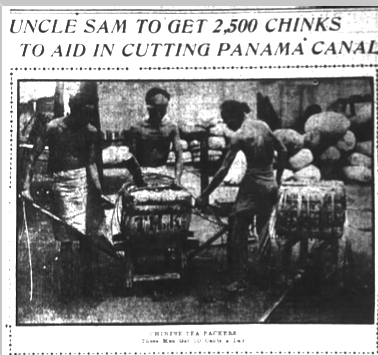
U. S. Getting 2500 "chinks" to work on Panama Canal


Chinese laborers were recruited to provide cheap labor in many parts of the world in the 19th century including Panama when railroads and the canal was built at the turn of the 20th century. A 1906 Atlanta Constitution article explained the procedures and policies for recruitment, treatment, and payment of the 2500 Chinese initially wanted to help dig the Panama Canal.

The tenor of the article is that the U.S. will be careful to be truthful in their recruitment procedures, making sure that each recruit fully understands the nature of the work, the living conditions, and what they will be paid.


However, the statement that each coolie will "be thoroughly scrubbed" suggests a condescending attitude that may indicate the men will not be accorded respectful treatment in other ways. Indeed, the preparation for their medical exam involves 100 men at a time coming into a hall "clad only in a piece of string and his paper tag."


The article describes and justifies the very low wages that will be paid on the grounds that they will make more than they would if they stayed in China. It also expressed concern about bringing too many Chinese because of their propensity to form unions, and the danger of strikes occurring which would impede the building of the canal.

3/2/14

Chop-Chop's Makeover: From Sidekick and Cook into Bruce Lee

         There have been changes over time in the media portrayal of Chinese, with more positive representations finally emerging.  In the past, Chinese might be portrayed like Hop Lee, a subservient houseboy who fawned over his employer on one hand, and on the other extreme, like Fu Manchu, evil incarnate, out to conquer the world.  Then by mid century they were replaced by the sagacious yet still inscrutable, detective, Charlie Chan. Next he was depicted as the brainy computer nerd by the 1960s.

             These changes involved replacing one stereotype with another; they did not involve changes within a specific character. A striking instance where a fictional character was rewritten drastically to reflect changing social attitudes was with Chop Chop, the token Chinese comic relief companion of the Blackhawk fighter squadron, a 1940s forerunner of the  "Magnificent Seven."

               Throughout the 1940s and well into the 1950s, Chop-Chop was used to provide comic relief in the Blackhawk comic  book where  artist Reed Crandall depicted him as a somewhat emasculated caricature.  Chop Chop is chubby, buck-toothed, wears a queue tied with a bow, and wears coolie looking clothes.  Speaking sing-song English, his gibberish is nonsensical or undecipherable.   An offensive racist stereotype by current standards, it was an accepted and typical of depiction of Chinese and other Asian males until beyond the middle of the 20th century.

               Primarily serving as Blackhawk's sidekick, Chop Chop flew on combat missions in the back seat of a fighter plane piloted by the squadron leader, Blackhawk, presumably because he did not have the skill to fly his own plane.  In hand to hand combat, while other members of the Blackhawk crew, all of European heritage, fought with hand guns, Chop Chop rushed into the fray armed only with a meat cleaver (after all, he was the group's cook).


         With changing times and more favorable attitudes toward Chinese after World War II,  Chop-Chop was "promoted" and even featured in his own comic, Chop Chop, from 1946 to 1955.

             In 1952,  he became cast as a full member of the team, and from 1955 to 1964, he was a more realistically drawn character. However, in the 1980s revival of the series, Chop-Chop was "demoted" wearing a variation of his original outfit (even clutching a meat cleaver on the cover of the first issue).

           When it was decided to portray him as proficient in martial arts, perhaps due to the popularity of Bruce Lee, Chop Chop was renamed, Liu Huang.  In the 1960s, Chop Chop (now Dr. Hands) endowed with beryllium-encased hands, could "smash through practically anything."  By the late 1970s, channeling Bruce Lee he was recast as a Chinese master of martial arts as well as the team's most skilled flier, "save for Blackhawk himself." In the 1980s he was no longer named Chop Chop, but Wu Cheng, a martial arts master.


           In the late 1960s he achieved the rank of Lieutenant, and is not only a master pilot but also a skilled mechanic.  Despite these achievements, he was still providing his skillful services as a cook. Some stereotypes may never change!

Source: http://en.wikipedia.org/wiki/Blackhawk_(DC_Comics)

2/28/14

Negative Media Images of Chinese

     Illustrations of "cartoons"and drawings as political and social commentary has a long history.


Chinese were targets of negative stereotyping in many images created during the late 19th century to promote anti-Chinese feelings that led to the Chinese Exclusion Act of 1882 that was renewed and continued until 1943.


  Popular forms of fiction such as dime novels in the early 1900s also generated negative images of Chinese, focusing on the seedy aspects of opium dens, tongs, and slave girls which in some form or another filled dozens of issues of Old and Young Brady, Secret Service Detectives.


Fast forward to the year 1941, and a new Chinese stereotype of being "smart" was suggested by this advertisement by a paper product company, the Container Corporation of America, which exclaimed, "Darned clever... those Chinese!"


The reference was not to Chinese Americans, however, but to Ts'ai Lun who invented paper back in the Han Dynasty. The corporate ad copy adhered to the stereotype of the mystical East, asserting that Ts'ai Lun's technique for paper invoked "mystic powers to raise the dead," whereas America's (corporate) magic lay in "low-cost, light-weight packages of paperboard."


2/8/14

Chinese Americans and Problems in U. S. Census Records

The decennial U. S. Census is an important source of information for many purposes including federal allocation of resources to states and localities as well as apportionment of seats to each state in the House of Representatives based on population size.  Information about individuals such as where they lived, what work they did, and demographic information is invaluable for genealogical and historical research.

However, getting complete and accurate census information is much more difficult than one might realize. Viewing a government video created for the 1940 census (records which were only released last year) is illuminating.  Even though the film uses a mock census interview, it shows how demanding the process was and one can imagine how many ways it could involve errors.


  Problems of getting valid information about Chinese immigrants is especially difficult. The unfamiliarity of Chinese names for census enumerators (most, if not all, from white European backgrounds) made for problems of accurate transliteration of names. The name order for Chinese being the reverse of Eurocentric names added inaccuracy. Distrust and fear of the purpose of the census, especially for the many Chinese with false or paper son names, undoubtedly led them to be absent when the census taker came. An earlier post gives more details of these problems that existed with census records of Chinese.

One illustration of other problems was the egregious error in some census data involved confusion of the codes used to distinguish Chinese (C 4) from Colored (C 2), the term used for decades for black Americans leading to an "overcount" in some cases because "Colored" was counted as "Chinese"as detailed not only for 1940, but also as early as 1910.  These are only two small examples of errors involving the count of Chinese. They are just the "tip of an iceberg" but I did not try to determine how large that iceberg might have been.

1/25/14

Landmark Habeas Corpus Cases of Jung Ah Lung, 1885 and Ju Toy, 1904-1905

    A Chinese laborer, Jung Ah Lung left the United States for a visit to China after obtaining a Customs certificate needed to gain reentry. When he returned, however, he was unable to present the certificate, saying that pirates robbed him in China. The Customs Collector denied his reentry, forcing him to stay on the ship in San Francisco bay despite the availability of a detailed description of his physical features in the Customs books and the support for his case by affidavits and other testimony supplied by a missionary in China, a United States Consul, an Oakland editor,  the Chinese Mission, and by other circumstances.


"In Re Jung Ah Lung" was an immigration case of major significance especially for Chinese immigrants during the early period of the Chinese Exclusion Acts, and for constitutional law relating to due process. The U.S. Attorney and Collector of Customs, sought to prohibit Jung Ah Lung from returning to the U.S. insisting that only official documents issued by federal immigration authorities, such as the "Return Certificate," were acceptable as evidence of U. S. residency. 

The Court allowed that the Collector of Customs under Section 9 of the 1882 Chinese Exclusion Act had the power to require returning Chinese laborers show a valid Certificate of registration.


However, Judge Hoffman noted, "But the section affords no color to the extraordinary pretension that the result of that examination shall be final and conclusive upon the rights of passengers."
He sided with the immigrant, holding that regardless of the Exclusion Act, a Chinese person claiming U. S. residency should be entitled to the same benefits of habeas corpus, and due process in presenting relevant evidence in court, as "any other human being in this country." Hoffman's position was appealed and upheld by the U. S. Circuit and U. S. Supreme Courts.

However, the victory for the Chinese was short-lived as this precedent for all immigrant rights to receive due process in court lasted only 20 years.   In 1904-1905 Ju Toy, a Chinese cook in Oakland, California was denied the right of habeas corpus to appeal denial of his reentry even though he presented his Certificate of Registration.


In the Ju Toy case, a U. S. District Court ruling initially favorable to the immigrant was reversed upon appeal in the U. S. Circuit Court (San Francisco) and then the U. S. Supreme Court. After "In Re Ju Toy," "due process" for ALL U. S. immigrants was limited to appeals within the executive branch, except when there was a claim of unlawful or arbitrary actions by immigration officials. Aliens and alleged citizens could no longer count on their "day in court" to contest the impact of immigration bureau decisions denying their right to be in the U. S.


1/12/14

Two Quite Different Cases, But Both Had Bad Outcomes for Chinese

Strong anti-Chinese sentiments were prevalent throughout the U. S. and Canada from the mid 19th to mid 20th century. Two examples illustrate the variety of contexts where Chinese faced unfair barriers to opportunities that were afforded to non-Chinese.

In 1892 the Chief of Public Safety in Pittsburgh, confronted by the problems of policing criminals of different nationalities, decided to appoint Yee Din, a Chinese as a policeman. Having a Chinese police officer, he thought, might be more effective in dealing with the Chinese population. Known as Jim Blaine, Yee was prepared to renounce his citizenship and allegiance to China and become a naturalized citizen of the United States, a condition for being a policeman.


Although Yee was deemed qualified to serve as a policemen, a judge, not ready to accept a Chinese in this capacity, denied his application.  Thus, "Chief Brown's idea to get at the Chinamen who violate the law ended and Yee Din did not become Pittsburgh's first Chinese policeman.

A second example comes from Canada over a quarter of a century later during Prohibition in 1935.
Suffering financially from the depression, the hotels in Saskatchewan lobbied successfully to get the right to sell beer by the glass.  Historian Joan Champ noted there were Catch-22 legal barriers against Chinese during Prohibition that excluded Chinese hotel owners because the law called for liquor license applicants to be restricted to people who were entitled to vote, a right that was denied to Saskatchewan Chinese until 1947. Thus, being unable to vote, Chinese hotel owners could not apply for a liquor license.

1/11/14

Early Chinese Immigrants Relied on the Post Office

Today, we rely heavily on electronic methods to communicate across space, but a century ago, written documents and letters sent by mail was the primary means of communication across distances.  If only we had an archive of these documents, we would have a rich source of for historical analysis.

For example, two collectors in the Cariboo District in British Columbia have created a website which they call a 'virtual museum' of pioneer North American Chinese. On this site, they show some of the fascinating Chinese artifacts, ephemera, and collectables they have gathered from around the Province that are probably similar to those found across North America. Many letters, or at least mailed envelopes, are part of the collection. A few examples are shown below.


If only we had the contents of those envelopes, we could learn more about the people who wrote and received these letters and learn more about the everyday life experiences of times past.

1/1/14

Year 2013 is Now "History:" Reflections of Chinese American History

        The Chinese American history posts on this blog are not "philosophical" essays by any stretch of the imagination, so the present post may come as a surprise.  Given that last night, New Year's Eve, was an evening when most of us did a bit, maybe too much, celebrating (of what?), today on January 1, 2014, I wonder what will become some of the 2014 additions to Chinese American history.

    One intriguing question is what exactly defines a "Chinese American?"  Compared to  the distant past, say, the 1930s, the variety of people who could be categorized as, or call themselves, "Chinese Americans" has become considerably more varied as the "face" of Chinese in America has changed greatly since the liberalized 1965 immigration law.


        Accordingly, one might think the content of Chinese American history would be more varied to reflect the subgroups of Chinese coming from different parts of China and other parts of the world. Compared with the earlier immigrants from Guangdong, mostly poor and less educated, many of the recent immigrants from Taiwan, Hong Kong, and some parts of mainland China are wealthy educated professionals while there are also the Fujianese immigrants at the other end of the ladder. These groups are arguably all Chinese. To what extent do these groups interact with each other socially, politically, culturally? How well do they get along with each other, how much are they aware of each other? Why or why not? My observations suggest they do not mingle much and may even not feel much respect toward each other.

          Yet, my sense is that many non-Chinese are unaware of these differences and generally see all of us as Chinese or Chinese Americans.  There are many social, political, and psychological aspects of these differences that should be researched, but don't yet seem to be adequately reflected in the historical analyses of Chinese America.  We may all "look the same" to outsiders, but looks can be deceiving.

        A different, but related issue of importance, is the relationship between Chinese in China and  Chinese in America, especially those born or long time residents in the U. S.  Although the Chinese in America and those in China are worlds apart in many respects, many non-Chinese tend to see us as members of one large group, Chinese.  And, while most American Born Chinese (ABCs) and even some Fresh Off the Plane (FOPs) and older Fresh Off the Boat (FOBs) experience some pride in many aspects of China's improved world status, we recognize that many policies and practices of Chinese in China are deplorable and dangerous.  And, what is worse, is that as U. S.- China relationships go, so will the way that we Chinese in America will be treated, or mistreated. If you doubt, just recall what happened to Japanese Americans after Pearl Harbor. History is known to repeat itself.

       The important impact of history can also be seen in our daily personal lives.  Many of us of a certain age have or had parents who were immigrants from China who came during the Great Depression and lived during World War II, and the Cold War, etc.   A"generation gap" existed between them and us that involved differences of values, facility with English and Chinese language, etc.  Now we have grown up, and most have become parents, (and for many, grandparents), we can see that there is still a "generation gap" between us and our adult, or adolescent, offspring but it is qualitatively different from the one that existed between us and our parents. Why? Because the historical era during which each generation grows up is typically quite different.  My parents grew up in difficult times in China while I grew up during the prosperous post WW II boom times.  My children, in turn, grew up in the 70s and 80s, which were markedly different from the 50s.

         This is a long-winded way of raising this question.  How was the relationship that you had with your parents different from the one you have (had) with your children? Implicit in this comparison is the impact of history.  That is, what was going on in the world when you were growing up is quite different from the world in which your children grew up.  History tries to explain the past, but not always accurately, since it gets rewritten occasionally, but my real question is whether we can use history to predict Chinese America in 2014.  I'll let you know what I think next January 1.